The call comes in on a Monday in April: "We've got a pothole by the entrance, can you fill it?" You drive over. There's the one by the entrance, eleven more behind the building, and one near the dumpster you can put your whole boot into.
Patching looks like the smallest job you do. It's also the one where a price per hole, a price per square foot or a price from memory goes wrong fastest, because a small repair is mostly the cost of showing up.
To price asphalt patching and pothole repair, measure every repair, add up the saw-cut feet, figure dig-out depth and tons of hot mix, then build the crew, equipment, disposal and the trip out around them. Divide the total by the square feet to get the job's unit price, and set a minimum charge that covers a crew and a truck for half a day no matter how small the hole is.
Measure every repair, not the pothole
"A pothole" isn't a unit of work. A 2-by-2 surface divot and a 12-by-7 base failure are both one pothole to the property manager. Walk the lot with a wheel and a can of paint.
For each repair:
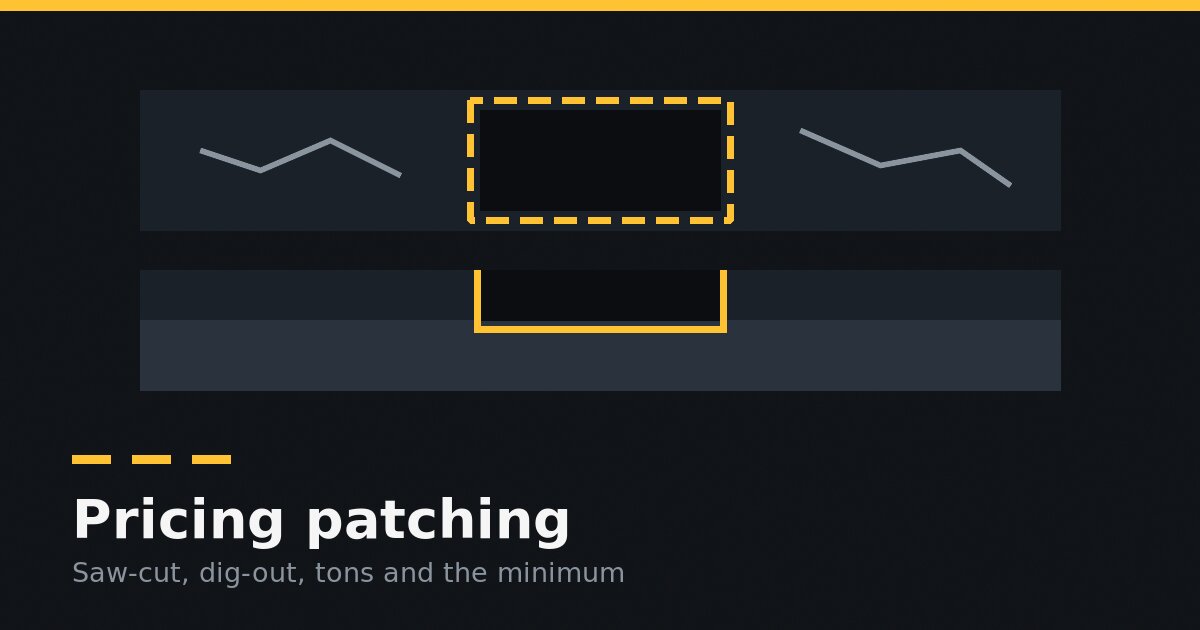
- Mark the cut lines. Square them up and go past the damage into sound pavement. A common practice is about a foot past the edge of the distress. The patch you price is the rectangle you'll cut, not the hole.
- Write down the size. Length and width of the painted rectangle.
- Probe the depth. Push into the bottom and the edges. Firm stone means you're replacing asphalt. Soft, wet or pumping material means base failure, and that's a deeper dig and stone.
- Photograph it with the tape in the frame.
The painted rectangles become the list on the proposal. When the invoice is bigger than "one pothole," the list with sizes and photos is the answer.
Work the quantities: saw-cut, dig-out, tons
Say the walk turns up ten repairs:
- Five at 6 by 8 feet: 48 square feet each, 240 in all, and 28 feet of cut around each, so 140 feet of saw cut.
- Four at 4 by 6 feet: 24 square feet each, 96 in all, and 20 feet of cut each, so 80 feet.
- One at 12 by 7 feet over soft base: 84 square feet and 38 feet of cut.
That's 420 square feet of patching and 258 linear feet of saw cut.
Hot mix. Say the existing asphalt is 4 inches and you'll replace it full depth:
420 sq ft × 4 in ÷ 12 × 145 lb per cu ft ÷ 2,000 = 10.15 tons
Hand work, tacked edges and compacting into a box run heavy, so carry a waste allowance. At 10 percent that's about 11.2 tons. Check your plant's mix design for the real unit weight, and use the asphalt tonnage calculator if you want a second set of eyes on the math.
Dig-out. The same 420 square feet at 4 inches is 140 cubic feet of old asphalt, about 5.2 cubic yards in place. Broken up, it takes more room in the truck than it did in the lot. Know where it's going and what they charge.
Base. The 12-by-7 failure needs another 6 inches out and stone back in: 84 × 6 ÷ 12 = 42 cubic feet, about 1.56 cubic yards. Say your stone runs 2 tons a yard compacted. That's about 3.1 tons of stone.
Tack. Every cut edge and the bottom of every box get tack. On a job this size it's a few gallons, and it's the line that gets skipped when the tack pot isn't on the truck. Keep it on the sheet.
Build the cost from your crew and equipment
A patch day is a crew day. Say a four-person crew at a loaded cost of $38 an hour runs a 10-hour day, and the saw, the skid steer with a bucket, the roller, the dump truck and the tack sprayer cost you $900 a day to own and run.
Here's the direct cost of the ten repairs, with clearly illustrative prices:
| Line | Cost |
|---|---|
| Crew: 4 × 10 hours × $38 | $1,520 |
| Equipment for the day | $900 |
| Hot mix: 11.2 tons × $85 | $952 |
| Tack | $40 |
| Stone: 3.1 tons × $22 | $68 |
| Saw blade wear: 258 ft × $0.60 | $155 |
| Disposal | $150 |
| Equipment transport and setup | $350 |
| Direct cost | $4,135 |
At a 30 percent margin the price is $4,135 ÷ 0.70 = $5,907. Divided by 420 square feet, that's about $14.06 a square foot for this job.
Look at where the money goes. The mix is $952 of a $4,135 job. Crew, equipment and the trip out are $2,770, two thirds of it. On patching, material is rarely what decides the price. Time on the lot is.
Set a minimum that covers showing up
Now take the call where it really is one pothole: 4 by 6 feet, 24 square feet.
At $14.06 a square foot, that's $337. But the crew still loads the truck, drives out, cuts, digs, tacks, places, rolls and drives back. Call it half a day of crew ($760), half a day of equipment ($450) and the same $350 to get there and back. That's $1,560 of cost before you've bought a shovelful of mix. At the same 30 percent margin, the price for showing up is $1,560 ÷ 0.70, about $2,229.
That's your minimum charge, and it goes on the proposal in writing: "Minimum charge $2,230 per trip." The number that makes sense for your company comes from your own crew and equipment costs, but the shape is the same everywhere. A price per square foot built on a full day of patching will lose money on every small call.
Two ways to make small repairs work for the customer and for you:
- Bundle them. Hold small repairs for a customer until there's a half day of work, or schedule them on the day you're already nearby.
- Put patching on the sealcoat proposal. A lot getting sealed next month has its repairs done the week before, and the trip out is already paid for.
Saw-cut patch, overlay patch or throw-and-roll
Price each one as what it is, because the customer will compare your numbers side by side.
Saw-cut and full-depth patch. Cut square, dig out, fix the base, tack, place in lifts your roller can compact, and roll each lift. This is the permanent repair, and it's the one priced above.
Skin patch or overlay patch. Mill or grind the area and place a thin lift over sound pavement. It's cheaper, and it doesn't fix anything underneath. Only price it where the base is firm.
Throw-and-roll. Cold patch tamped into the hole. It's an emergency repair that gets the lot open this afternoon and fails when the weather turns. Price it by the visit, and write "temporary" on the proposal and the invoice.
If the plant hasn't opened yet or has already closed for the season, you're choosing between cold patch now and a permanent patch later. Price both, with dates, and let the customer pick.
What goes on the proposal
- Each repair by location and size, or a marked-up site photo with the rectangles numbered.
- The depth you priced, in inches of asphalt and inches of stone.
- A unit price for base that goes deeper than you probed: per square foot, or per ton of stone.
- The minimum charge.
- What's excluded: sealcoat over the patches, striping, repairs the customer adds on the day.
When the crew opens a box and the base is soft another foot down, the unit price turns the change order into arithmetic. See pricing pothole repair per hole or per square foot for the short version of the depth math, and walking the lot before you price it for what to look for before you paint the cut lines.
Questions contractors ask
Should I price pothole repair per hole or per square foot?
Per square foot, built from the rectangles you'll cut, for anything bigger than a few small uniform holes. Per hole works only when every hole is about the same small size. Either way, a minimum charge protects you on the one-hole call.
How much hot mix does a patch take?
Square feet × depth in inches ÷ 12 × 145 ÷ 2,000 gives tons, using your plant's unit weight in place of 145 if it's different. A 4-by-6 patch at 4 inches is about 0.58 tons before waste.
What should a minimum charge include?
Everything the crew costs you to show up and do one small repair: loading, drive time both ways, the crew and equipment for the time on the lot, and getting it all there, with your margin on top.
Can I patch over soft base?
You can, and it comes back. Dig out the soft material, replace it with compacted stone and then patch. If the customer won't pay for base, write down that they declined it.
Where Pavr fits
Pavr is job management software for paving, sealcoating, striping and concrete contractors. Asphalt patching and pothole repair come built in, and so does equipment transport and setup. The cost of showing up sits on the estimate as its own line. Your plant price and crew rates sit behind every line, and you see the margin before the proposal goes out. See how estimating works.
Was this useful?
It tells us what to write more of.