It's Tuesday afternoon. The mill and fill at the medical office is set for tomorrow: the plant has your order, four trucks are booked, and the crew knows to be at the yard at 5:30. Then the milling sub calls. Their machine is still on a county job across town, and they can get to you Thursday. The striper, who you told "the week after," is asking whether Friday works, because they have a hole.
Nothing about that call is unusual. Subcontracting milling and striping lets a paving company take work it doesn't have the machine or the people for. It also puts two other companies' schedules between you and your paving day. The work is in getting the sub's price and the sub's date right before the customer signs, not after.
How to subcontract milling and striping without losing days
Get a written quote for each job, in the same units as your estimate, with the trip charge and minimums spelled out. Put your markup on it like any other cost. Then schedule in the order the work has to happen: the mill, then the paving, then the striping, with each sub's date confirmed in writing the week before and again the day before. Your paving crew should never wait on a sub. A sub can wait on you.
Get a milling quote you can price from
"About two bucks a yard" from a phone call is not a price. Ask for a quote on the job, and make sure it answers these:
- Square yards at a depth. Two inches and three inches are different prices. So is milling to a variable depth to fix a profile.
- Equipment transport and setup, which the sub's quote will call mobilization. Per move, not per job. If the lot has two areas the machine has to trailer between, that may be two.
- The minimum. Small lots often hit a day minimum rather than the square-yard price.
- Hand work. Around catch basins, along curbs and against buildings, the big machine can't get close. Who does it, and with what?
- Sweeping. Is the sweeper in the price, or yours to bring?
- The millings. Who transports them, and who keeps them? Recycled asphalt has value to some plants and some subs. Write down who owns it.
Here's how the numbers go on a 6,000 square yard lot milled 2 inches. Say the quote is $2.10 a yard plus $1,500 for equipment transport and setup. That's $12,600 plus $1,500, or $14,100 for the milling.
Now the millings. Compacted asphalt runs about 110 pounds per square yard per inch at a unit weight of 145 pounds per cubic foot. Two inches over 6,000 yards is about 1.3 million pounds, or roughly 650 tons coming off that lot. If your tri-axles transport 20 tons a load, that's 33 loads. If the sub's quote says "millings by others," that's your trucking, and it belongs on your estimate as its own line.
Put your markup on the sub's price. Say you carry 10 percent on sub work: $14,100 becomes $15,510 on the proposal. You're carrying the schedule, the customer and the risk that the sub doesn't show, and that's worth pricing. If the trucking for the millings is yours, price it the way you price any trucking, by the hour or the load.
Get a striping quote that matches the lot
Striping quotes go wrong in the counting. Before you ask for a price, count the lot yourself:
- Stalls, and lines. A row of 30 stalls is 31 lines, not 60. Ask whether the sub prices by the stall or by the line, and check the count against yours.
- Symbols and words. Accessible stall symbols, arrows, "STOP," "FIRE LANE."
- Long lines. Fire lane and curb painting by the linear foot.
- Layout. On a new lot or a changed layout, somebody has to lay it out before anyone sprays. Is that in the price?
- Trips. Each trip is a separate charge. If the paving goes in two phases, the striping probably does too.
For more on the count itself, see pricing parking lot striping.
Schedule in the order the work happens
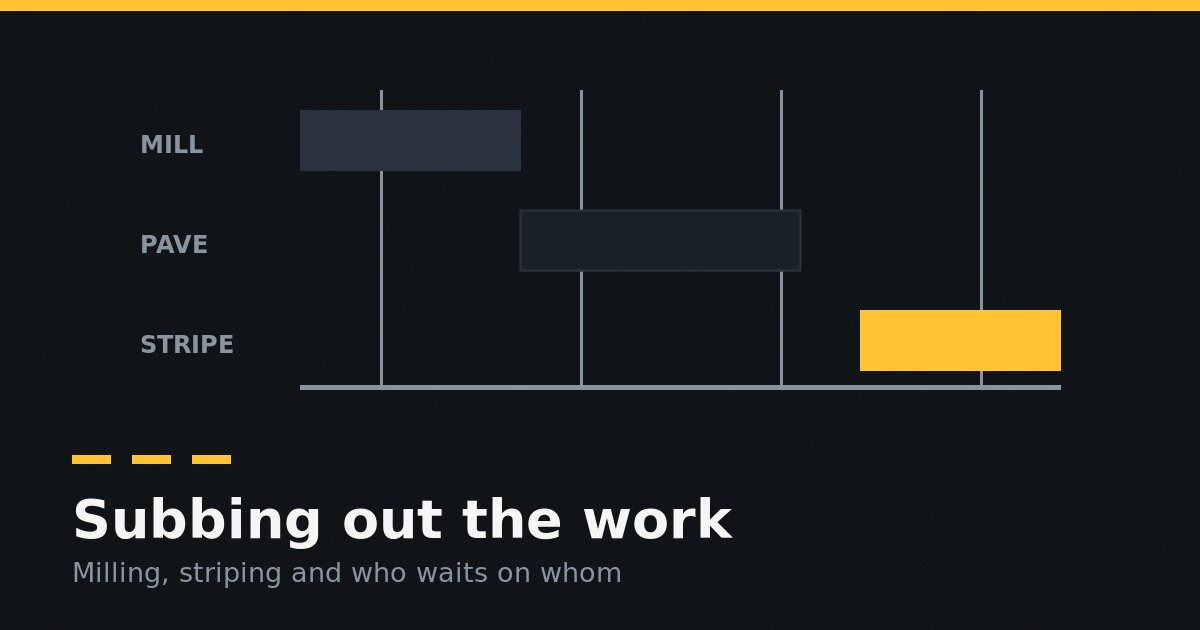
The order on a mill and fill is fixed. The mill goes first, the paving follows, and the striping comes last. What matters is who pays for a wait.
The paving crew waits on the mill. That's the expensive one. Your crew, your trucks and your plant order are all set around the milled surface being ready. Say a seven-person crew costs you $45 an hour loaded and works a 10-hour day. A day of that crew waiting is $3,150 in labor, before the trucks you hired and the equipment you're paying for either way.
So don't book the paving day until the mill is confirmed in writing. Pave the day after milling if you can, not the week after. A milled lot open to traffic and rain is a lot you'll be sweeping, patching and apologizing for.
The striper waits on you, and that's fine. Striping a new mat has its own timing. Check the paint maker's guidance for fresh asphalt. If the lot is getting sealcoat, new asphalt usually needs to cure first. Follow the sealer maker's product sheet, and the paint goes down after the sealer has dried. The striper's date is set by your paving date, never the other way around.
Confirm twice. A week out, send each sub the address, the date, the start time, the contact on site and the plan sheet or the stall count. The day before, confirm again. Subs have other customers. The one who confirms in writing is the one who shows up.
Tell the customer one date, from you. The property manager shouldn't be taking calls from your striper about when to close the lot. You own the schedule, so you make the calls.
When the mill finds something
Milling is where the lot tells you what the estimate couldn't see. Soft base under the surface, a thicker old mat than the cores showed, a catch basin that needs raising. When the sub finds it, the extra depth or the dig-out is a change to the job.
Stop and write the change order for your customer before the extra work happens. Then settle the sub's extra on the same terms: extra yards or extra depth at the quoted rate, in writing. If you pay the sub for extra work you never got signed by the customer, you paid for it yourself. The change orders guide covers how to write one on the lot.
The paperwork and the money
Before a sub touches your lot you want three documents: a certificate of insurance naming your company as additional insured, a W-9, and a signed subcontract that states the work, the schedule and when they get paid. Write down every expiration date. A certificate that was good in April can lapse in the middle of your July job, and the sub doesn't work again until the new one is in your hands.
Settle the payment terms up front. Net 30 from their invoice is a common term. If your customer holds retainage from you, the subcontract can hold the same from the sub, released on the same terms. Tying the sub's payment to yours with pay-when-paid or pay-if-paid language is treated differently from state to state, so check your state's rules before you rely on it.
When the sub's invoice comes in, check it against the quote: yards milled against yards quoted, stalls against your count, equipment transport and setup charges against trips. Then put it against the job. A milling line that ran $1,800 over tells you something about the next estimate, but only if you look at it.
Questions contractors ask
Should I mark up a subcontractor's price?
Yes. You're carrying the schedule, the customer relationship and the risk that the sub is late or wrong. Price that like any other cost on the estimate, at a markup you decide from your own numbers.
Who should pay for trucking the millings?
Whoever the quote says, which is why it has to say. Before you price the job, get it in writing: who transports the millings, who keeps them, and whether they're credited anywhere.
How soon after milling should we pave?
As soon as the schedule allows, ideally the next day. A milled surface open to traffic and weather gets dirty, holds water and can loosen at the edges. All of that is cleanup on paving day.
How do I keep the striper from showing up too early?
Give them a date only after the paving is done, or tie their date to yours in writing: "the Thursday after we pave." Confirm the day before.
Where Pavr fits
Pavr is job management software for paving, sealcoating, striping and concrete contractors. The milling, the paving and the striping go on one estimate and one proposal for the customer, and each crew sees its own part of the job. The striping waits on the paving without anyone watching the calendar, and you can change that wait. Subs confirm their day from a link in their email. They don't need an account. When a sub's invoice is approved, it posts to the job next to what you estimated. A sub's insurance certificate gets a reminder at 30 days, 7 days and the day it expires. See how one job across trades works.
Was this useful?
It tells us what to write more of.