It's the last week of September. You've got 30 lots signed and not sealed, and the crew that did five a day in July did two yesterday. The morning was 44°F. By the time the pavement warmed up it was 10:30, and by 3 the shadow of the building was already across half the lot. The property manager for the medical office wants to know why their lot isn't done yet. The forecast shows a front coming through next Tuesday.
Fall sealcoating isn't the same job as summer sealcoating with jackets on. The cutoffs are closer, the days are shorter, and the season ends on a night, not a date.
The temperature cutoff for fall sealcoating
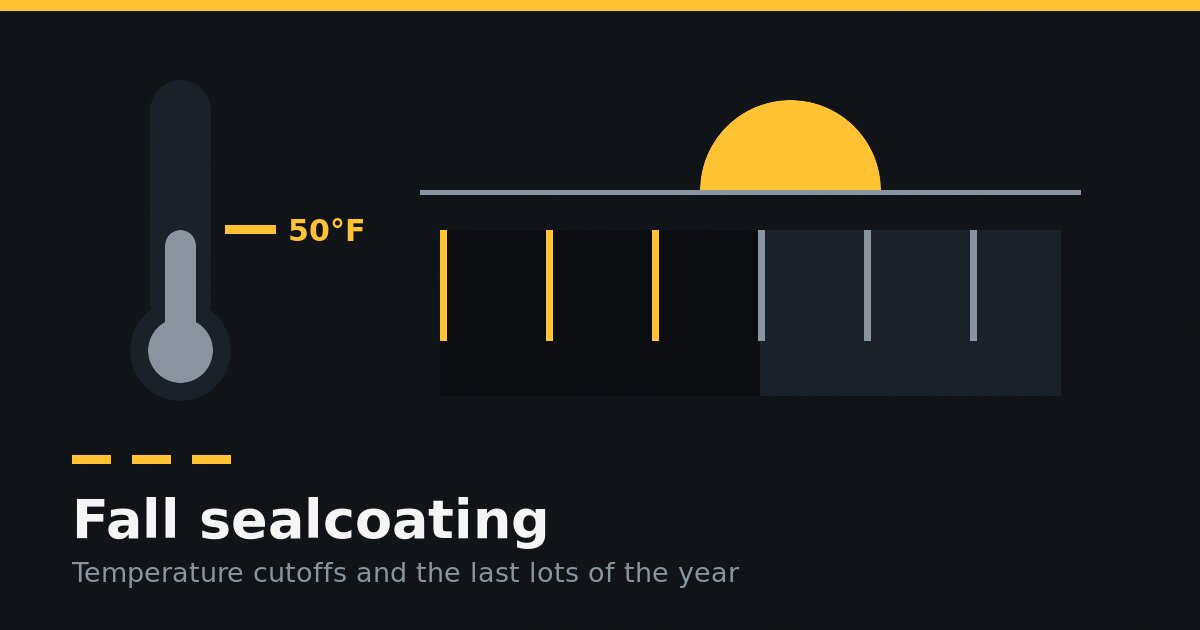
Most sealcoat manufacturers call for the air and the pavement to be at least 50°F and rising when you apply, with no rain expected and temperatures staying above 50°F for roughly the next 24 hours while it cures. Your product sheet is the rule, and some products and additives work a little cooler. In the fall that turns into a shorter window each day, a late start after the pavement warms, an early stop so the sealer isn't going into a cold night, slower drying, and fewer lots per day. The last sealing day of the year is usually set by the overnight lows, not the afternoon highs.
Read the rule the way the product sheet means it
Air and pavement. A 55°F afternoon over a lot that sat in the shade all morning can still have pavement in the 40s. Put an infrared thermometer on the pavement in the sun and in the shade before the rig starts.
"And rising" is about the morning. 50°F at 9 a.m. with the sun coming up is a good start. 50°F at 3 p.m. with the sun going down is the end of the day, even if the number is the same.
The night matters. Sealer that goes down at 2 p.m. is still curing at midnight. A night in the 30s after an afternoon at 58°F is how a lot ends up tracking, washing out or looking blotchy by spring. Check the overnight low for the lot's town, not just the high.
Moisture counts too. Heavy dew, fog or a damp morning puts water on the pavement, and sealer doesn't like to go down on it. Cool, humid air slows drying even when the temperature passes. Wind helps drying, and so does sun.
The daily window, and what it does to capacity
This is the arithmetic that tells you whether your backlog is going to get done. The numbers are illustrative. Use your own crew's times.
Say each lot takes your crew 1.5 hours to prep and seal, plus 30 minutes to pack up and get to the next one. That's 2 hours a lot.
- July: You can seal from 7 a.m. to 5 p.m., a 10-hour window. 10 ÷ 2 = 5 lots a day.
- Late September: The pavement in the sun passes 50°F around 10:30 a.m., and you want to stop by 2:30 p.m. so each lot gets some warm afternoon before the evening cools off. That's a 4-hour window. 4 ÷ 2 = 2 lots a day.
Now the backlog. You have 30 lots left, so at 2 a day you need 15 good sealing days.
Pull last year's logs from the same stretch, say September 22 through October 19. That's 20 weekdays. Count the days that were warm enough and dry enough to seal. Say it was 11.
- Lots you can seal: 11 days × 2 lots = 22 lots
- Lots left over: 30 − 22 = 8 lots
Those 8 lots are the decision you want to make this week, not the week of Thanksgiving. You can run a second rig on the good days, work Saturdays when the weekend forecast is warm, or move 8 lots to spring now and tell those customers while it's still a plan instead of an apology.
Which lots go first
When there are more lots than good days, the order matters.
Shaded lots first. A lot on the north side of a building, or under big trees, loses sun early and dries slowest. Seal it while the days are still relatively warm. The wide-open lot that sits in full sun all day can wait longer.
Big lots early. A lot that needs your whole 4-hour window can't be split around another job. Do it while the window is still 4 hours, not 3.
Hard deadlines. The school that needs it done over a long weekend, the retail lot that can only close on a Sunday. Place them on the calendar first and fit the rest around them.
New asphalt last, or in spring. A lot paved in August may not have cured long enough for your sealer's product sheet. If the wait runs past your last good days, it goes to spring. Sealcoat cure time and new asphalt covers the waits.
Crack filling keeps going
Hot-applied crack sealant often has a lower temperature limit than sealcoat, so read that product's sheet too. The cracks need to be clean and dry, with no frost in them.
Fall is also a good time to crack fill. Cracks open wider in cold weather, so sealant that goes in during the fall fills the crack close to its widest. For the 8 lots that are moving to spring, crack filling them now keeps water out of the base over the winter, and it's work your crew can still do on a cool day. Crack filling vs. sealcoating explains the difference to a customer, and pricing crack filling covers the numbers.
Tell the customer early, and put spring in writing
A customer who hears in September that their lot might move to spring is usually fine with it. A customer who hears it in November isn't.
Send the lots at the end of your list a plain message now: "Your lot is scheduled for the week of October 12. Sealcoat needs 50°F and dry weather through the next night, and October doesn't always cooperate. If we don't get a good stretch that week, we'll seal it first thing in spring at the price you signed."
That last part needs to be true on paper. Check the proposal's expiration date and your terms. If sealer prices go up over the winter, you want to have decided now whether you're holding the price, not argue about it in April. If you took a deposit, say what happens to it.
Striping follows the same logic. If the sealcoat moves to spring, the restripe usually moves with it, since lines painted now would disappear under the sealer in spring.
Don't let the material freeze
Sealer and other water-based products can be ruined if they freeze, and a tote in an unheated trailer can freeze on the first hard night.
Put a number on it. Say a 275-gallon tote of sealer concentrate costs you $3.00 a gallon.
- One frozen tote: 275 × $3.00 = $825, plus getting rid of it
Order material by the week in October, not by the month. Know where anything left over will spend the winter before the first freeze warning, not after. The same goes for traffic paint and anything else in the yard that's water-based. Your supplier's storage instructions give the minimum temperature.
The last lot
When the forecast shows nights settling below your product's limit and not coming back, call it. Don't seal a lot on a warm afternoon in front of a freezing night because it was the last one on the list. A lot that looks bad in April is a callback, and it costs more than the spring trip would have.
Then clean out the rig the same week, before anything freezes in the tank, the pump or the lines. Winterizing paving equipment when the plant closes covers the machines.
Questions contractors ask
What's the lowest temperature for sealcoating?
Most manufacturers call for at least 50°F and rising, for both the air and the pavement, with temperatures staying above that for about 24 hours after application. Some products and additives allow a little lower, so follow your product sheet.
Can you sealcoat in October?
In many places, yes, on days that pass the product's temperature rule and stay dry through the next night. The window each day is shorter, so plan for fewer lots per day.
How long does sealcoat take to dry in cold weather?
Longer than in summer, and it depends on the product, temperature, humidity, wind and shade. Keep traffic off until it's dry, which in the fall can mean well past the usual 24 hours in shaded areas.
Can crack filling be done in cold weather?
Often, yes. Hot-applied crack sealant usually has a lower temperature limit than sealcoat, and cracks are wider in cold weather. The cracks need to be clean, dry and free of frost.
Where Pavr fits
Pavr is job management software for paving, sealcoating, striping and concrete contractors. Every account starts with a weather rule per trade, including 50°F and no rain for sealcoat, and you can change it to match your product. The forecast flags the sealcoat jobs that won't make it, and a day that fails moves as one batch to the next day that passes, so the lots at the end of your list move together instead of one phone call at a time.
Was this useful?
It tells us what to write more of.