Friday afternoon, the foreman texts you photos of five timesheets. On Tuesday the first truck was late and the crew sat at the yard from 6:00 to 7:15. Three sheets start Tuesday at 6:00 and two start at 7:15. Every day has "30 min lunch" written in, including Thursday, when you know they ate standing at the paver because the plant was running behind. One sheet is missing Wednesday entirely.
Somebody's going to get paid wrong this week. The only question is whether it's in their favor or yours, and whether anyone finds out.
What a crew time clock has to get right
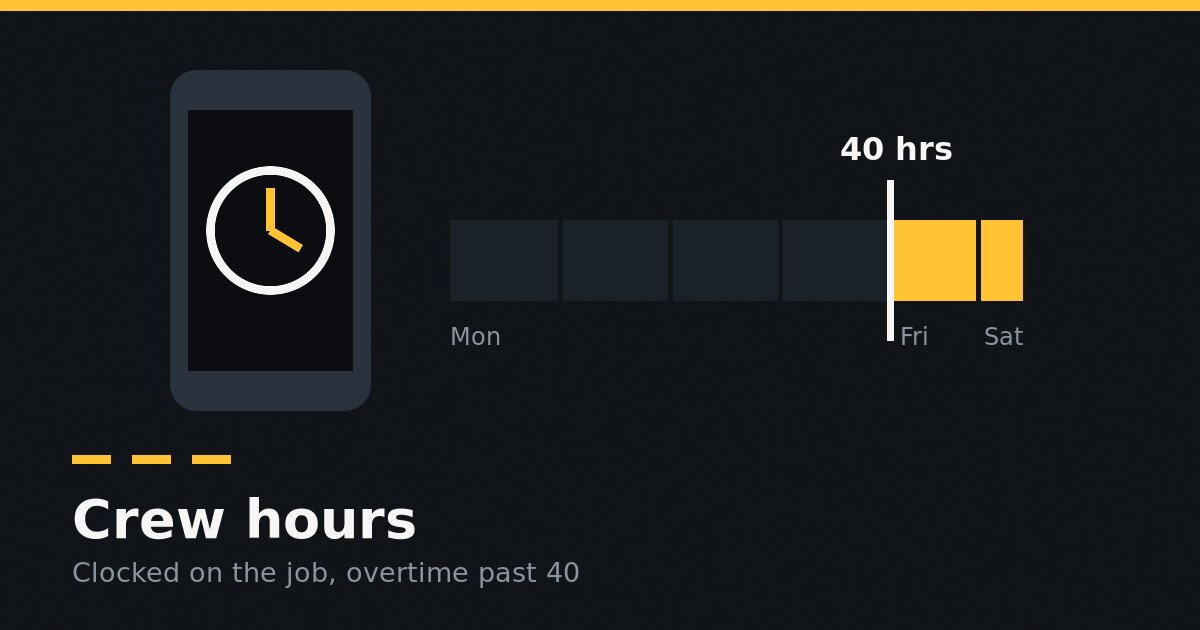
A crew time clock that holds up records the time each person actually started and stopped, on the job, when it happened, not written in at the end of the week. It records breaks as they're taken instead of assuming them. And it feeds overtime figured the way federal law figures it: anything over 40 hours in a fixed seven-day workweek is paid at one and a half times the regular rate, with your state's rules on top. Get those three right and payroll stops being a Friday argument.
This is a working summary for contractors, not legal advice. The federal rules are the Fair Labor Standards Act and the Department of Labor's regulations on hours worked. Your state may add more.
When the paid day starts
This is the part paper timesheets get wrong most often, because the rule surprises people.
A normal commute isn't work time. Driving from home to the place the workday starts generally isn't paid.
Once the workday starts, travel is work. If the crew reports to the yard, loads the trailer, hooks up the roller or gets instructions for the day, the workday has started. The drive from the yard to the lot is paid time, and so is the drive back to drop the equipment at the end of the day.
Waiting is work when you told them to wait. The crew sitting at the yard until 7:15 because the first truck is late is on the clock from the time they were told to be there. On Tuesday in the opening, the three sheets that start at 6:00 are the right ones.
So decide where your crew's day starts and say it plainly: "The day starts when you get to the yard." Or, if people drive their own trucks straight to the lot: "The day starts at the lot." Then make the clock match. The Department of Labor's rules on travel time, in its regulations on hours worked, are worth reading once, because a crew that meets at the yard is common and so is getting this wrong.
Breaks: what's paid and what isn't
Short rest breaks are paid. Under federal rules, short breaks, typically 5 to 20 minutes, count as hours worked. A water break in July doesn't come off anyone's time.
Meal periods can be unpaid, if they're real. A meal period, typically 30 minutes or more, can be unpaid only when the person is fully relieved of work. Eating a sandwich while watching the screed isn't relieved.
Some states require meal or rest breaks. Federal law doesn't require them, but a number of states do, with their own timing rules. Check your state labor department's rules before you write your policy.
The expensive mistake is the automatic deduction. Here's what it costs. Say a laborer earns $24 an hour and already works past 40 hours most weeks, so any extra time is overtime at $36. Every day has a 30-minute meal break written in, but the crew works through it most days.
- Time owed per person per week: 30 minutes × 5 days = 2.5 hours
- At the overtime rate: 2.5 hours × $36 = $90 a person, each week
- A crew of 8: 8 × $90 = $720 a week
- A 20-week season: 20 × $720 = $14,400
That's wages owed, not a rounding error. Record the break when it's actually taken, and don't write one in when it isn't.
The 40-hour week, figured right
The workweek is fixed. You pick a recurring seven-day period, say Monday through Sunday, and every week stands alone. It doesn't have to match the calendar week, but it can't change from week to week to avoid overtime.
Each week is its own. You can't average two weeks. If a rainy week is 30 hours and the next dry week is 50, that's 10 hours of overtime in the second week, even though the two weeks total 80.
Overtime is time and a half of the regular rate. Say a laborer earns $24 an hour and works 52 hours in the week.
- Regular: 40 hours × $24 = $960
- Overtime: 12 hours × $36 = $432
- Total: $1,392
The regular rate isn't always the hourly rate. Production bonuses and certain other pay can raise the regular rate that overtime is figured on, and when someone works at two different rates in one week, the overtime is generally figured from both. If you pay bonuses or split rates, check the Department of Labor's overtime guidance or ask your payroll provider.
Some states count by the day, too. California is the best-known state with daily overtime, and a few others have their own rules. Public jobs with prevailing wage have their own requirements on top of that.
A salary doesn't make a foreman exempt. A foreman who runs a screed or a roller for much of the day is often still owed overtime. Whether someone is exempt depends on their actual duties and pay, not their title.
Clock in on the job, not on Friday
The fix for Friday's texted timesheets isn't a stricter form. It's recording the time when it happens.
Each person clocks in and out on their phone. The time is the time they tapped, not the time they remembered. Location taken at the tap shows they were on the lot.
The foreman can clock in the whole crew. For the laborer whose phone is dead, or a crew that meets at one truck, the foreman taps them in together. Nobody stays off the clock because of a phone.
No signal is normal. The back of an industrial park, a rural driveway. The clock-in has to save on the phone and send itself later with the time of the tap, not the time it went up.
Hours get approved before payroll. The foreman or the office looks at the week, fixes the missed clock-out with a note saying why, and approves. A change with a reason is a correction. A change without one is the kind of thing a wage claim is made of.
Where the hours go next
Hours on the job do two things. They pay people correctly, and they tell you what the job cost.
A lot you estimated at 60 crew hours that took 84 isn't a payroll problem. It's a labor rate or a production rate that needs a look, and you only see it if the hours landed on the job instead of on a sheet. Job costing for paving contractors covers how that comparison works. On T&M work the same hours are the bill, so they have to be right the day they're worked. T&M work without the argument goes through the daily sign-off. And when a customer disputes how long the crew was there, clocked hours back up the daily log.
Questions contractors ask
Is drive time from the yard to the job paid?
Generally yes. If the crew reports to the yard first and starts work there, such as loading equipment or getting instructions, the drive to the lot is work time. An ordinary commute from home to the first work location generally isn't.
Do I have to pay for lunch breaks?
A meal period of typically 30 minutes or more can be unpaid if the worker is fully relieved of duty. Short rest breaks of about 5 to 20 minutes are paid. Some states require meal or rest breaks, so check your state's rules.
When does overtime start for a paving crew?
Under federal law, after 40 hours in the workweek, at one and a half times the regular rate. Some states, like California, also have daily overtime rules.
Can I average hours over two weeks to avoid overtime?
No. Each workweek stands alone under federal law. A 30-hour week followed by a 50-hour week means 10 hours of overtime in the second week.
Where Pavr fits
Pavr is job management software for paving, sealcoating, striping and concrete contractors. The crew clocks in on the job from their phones, with location taken at the tap, and the foreman can clock in the whole crew at once. Breaks go on the clock with Start break and End break, so a meal break comes off the hours only when someone actually took one. With no signal, clock-ins save on the phone and go up when there's signal, and nothing is sent twice. Approved hours come out as a payroll CSV with regular and overtime hours split at 40 hours in the workweek you set. The crew side works in English and Spanish.
Was this useful?
It tells us what to write more of.