The property manager wants it all at once. New surface course on the lot the week of the 12th, sealed, fresh lines, done before the new tenant opens. "Can't you just do it all that week?"
You can pave that week. You can put lines down that week. You can't seal it that week, not if you want the sealer to stay on the lot. The answer is a schedule with two waits in it, and a proposal that says so before anybody signs.
How long to wait: sealcoat cure time and new asphalt
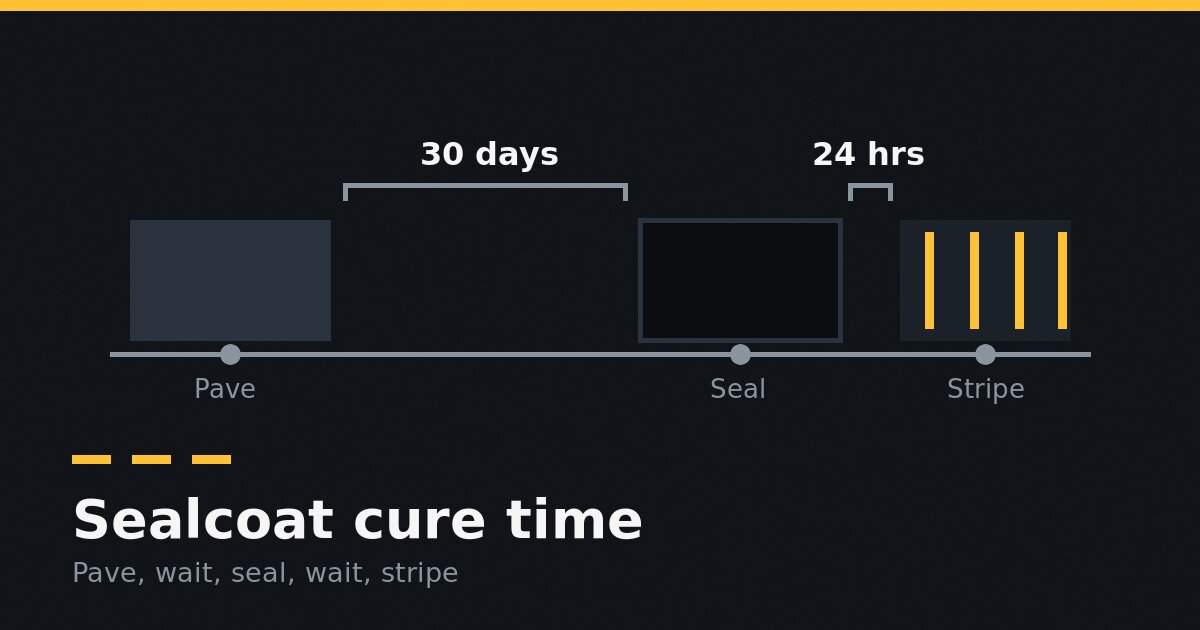
New asphalt generally needs to cure before it's sealcoated. Manufacturers commonly call for at least 30 days, and some product sheets ask for longer, especially in cool weather. After sealcoat goes down, it usually needs about 24 hours to dry before vehicle traffic and before the striper paints over it, and longer when it's cool, humid or shaded. So a new lot runs in this order: pave, put down lines so the lot can open, wait for the asphalt to cure, sealcoat, wait for the sealer to dry, and stripe again.
Your sealer's product sheet is the rule. The numbers here are common starting points, not a spec.
Why new asphalt has to wait
Fresh hot mix still has light oils working their way out of the binder. Sealer put over them may not bond well, and the new surface is still tender enough to scuff under a power-steering turn. Give it time and the oils cure off, the surface firms up, and the sealer has something to hold.
The wait depends on the weather. A lot paved in a hot June cures faster than one paved in a cool September. If you paved late in the season and the product sheet's wait runs past the last good sealing weather, the honest answer is spring. Tell the customer that when they sign, not in October.
Patches are different. A few dig-out patches in an old lot are a small share of the surface, and plenty of contractors seal over them sooner. Read the sheet and use judgment on how much of the lot is new.
The lot can't open without lines
A retail lot can't sit for a month with no stalls, no fire lane and no accessible parking marked. So new asphalt usually gets striped twice.
The first pass, right after paving. The striper lays out the lot from the plan and paints it once the mat has cooled and is dry. Fresh asphalt soaks up paint, so this coat won't look as crisp as the next one, and that's fine. Its job is to let the lot open safely. Accessible stalls, aisles and signs follow the 2010 ADA Standards and any state or local rules from day one, not after the sealcoat.
The second pass, after the sealcoat dries. The sealer covers the first lines completely, so the final striping goes down on the sealed surface. That's the coat the customer will look at for the next few years.
Mark the layout before you seal
Sealer erases every line on the lot. A striper who shows up to a black lot with no marks is laying it out from scratch, and the stalls may not land where they were.
Before sealing, spot the layout. Put a small paint mark or a tape mark on the curb or wheel stop at the end of each stall line, mark the corners of the accessible stalls and aisles, and photograph each row. Write down the stall width and count. Some stripers do this themselves the day before. Either way, somebody owns it.
Here's how much paint layout that saves. Say the lot has four rows of 16 stalls. Stalls share lines, so each row is 17 lines, not 32.
- Lines: 4 rows × 17 = 68 stall lines
- At 18 feet each: 68 × 18 = 1,224 linear feet
That's 68 line ends to find again on a black lot. Marked before sealing, it's a quick job with a chalk line. Unmarked, it's measuring every row from the plan.
A worked schedule
Say the lot is paved on Tuesday, May 12, 2026, and your product sheet calls for 30 days of cure and 24 hours of dry time.
- Tuesday, May 12: Pave.
- Wednesday, May 13: First striping pass once the mat is cool and dry. The lot opens.
- Thursday, June 11: The earliest sealcoat date, 30 days after paving. Mark the layout the day before.
- Friday, June 12: Final striping, 24 hours after the sealer went down, if it's dry.
Check the dates: May has 31 days, so May 12 plus 19 days is May 31, and 11 more days is June 11. That's 30.
Now say the forecast for June 11 calls for rain. The sealcoat slides to the next dry day, and the final striping slides with it. Move them together, as one change, and tell the customer both new dates in the same message. Moving the schedule on rain days covers the rest of that.
Close the lot to traffic for the sealcoat day and the dry time after it. On a retail lot that often means sealing half the lot at a time, or sealing on a day the business is closed.
Price the waits into the proposal
A schedule with two waits in it costs more than one trip. Price it that way from the start, not as a surprise.
Equipment transport and setup for each trip. The striper comes twice. Say your striper charges $350 for the trip and $5.00 a stall line on this lot.
- Each striping trip: 68 lines × $5.00 = $340, plus $350 equipment transport and setup = $690
- Two trips: 2 × $690 = $1,380
If you priced one trip, you're $690 light before any paint goes down. The same goes for the sealcoat crew coming back 30 days later. That's its own trip, with its own transport and setup, not a continuation of the paving.
Put the order and the waits in writing. One line in the proposal saves the argument: "Sealcoat is applied no sooner than 30 days after paving, weather permitting. Final striping follows once the sealer is dry. A temporary striping pass is included so the lot can open after paving." When the property manager asks why the sealcoat crew isn't there the week of the 12th, the answer is already signed. Pricing parking lot striping and pricing sealcoating jobs cover the unit prices.
Before the cars come back
A few things decide when the lot can reopen after each step.
- Sealcoat: Foot traffic is often fine within hours on a hot day, and vehicle traffic commonly waits about 24 hours. Shaded areas along a building dry slower than the open lot, so check them before you pull the barricades.
- Paint: Traffic paint usually dries fast in warm weather, but read the can. Keep cars off until it's dry, or you'll be repainting tire tracks.
- Cool nights: A 55°F night after a sealcoat day slows the dry time. Plan to reopen later in the morning, not at dawn.
Questions contractors ask
How long should new asphalt cure before sealcoating?
Manufacturers commonly call for at least 30 days, and some ask for longer, especially in cool weather. Follow your sealer's product sheet.
How long after sealcoating can you stripe?
Usually about 24 hours, once the sealer is completely dry. Cool, humid or shaded conditions stretch that, so check the shaded parts of the lot before the striper starts.
Do new parking lots need to be striped twice?
Usually, if they'll be sealcoated. The first pass lets the lot open safely right after paving, and the sealer covers it, so the final lines go down after the sealer dries.
How long before cars can drive on new sealcoat?
Commonly about 24 hours, depending on the product and the weather. Check the product sheet and the slowest-drying spots on the lot before you reopen.
Where Pavr fits
Pavr is job management software for paving, sealcoating, striping and concrete contractors. The paving, the sealcoat and the striping go on one estimate and one proposal, and each crew sees its own part of the job. The sealcoat crew's part waits 30 days for new asphalt to cure, and the striping waits 24 hours after the sealcoat, on their own, and you can change either wait to match your product sheet. See how one job runs across trades.
Was this useful?
It tells us what to write more of.