February is when you find out
In most of the country, paving stops when the plants close. Somewhere between Thanksgiving and the first hard freeze, the last lot gets rolled, the crews go on unemployment or onto snow, and the owner goes into the office to find out whether the season made money.
That's backwards, but it's how it goes at a lot of paving companies, so at least use the time well. The off-season is the only stretch of the year when you can change how the business runs without a crew waiting on an answer. Here's a checklist, in the order that pays off.
1. Close out every job for real
Before you look at anything else, make sure every job from the season is actually done. Not paved. Done. That means the final invoice is sent, retainage is requested, the punch list is signed off, change orders are billed and subs are paid.
You'll find money here. Most seasons turn up a change order that got done and never billed, a retainage release nobody asked for, or a final invoice still sitting in draft. Find them before they're old enough that the customer has forgotten they owe you.
2. Job cost the whole season, by type
Pull every job and line up the estimated cost against the actual cost. If you don't have actuals per job, this is the year to start, because you can't do the next step without them.
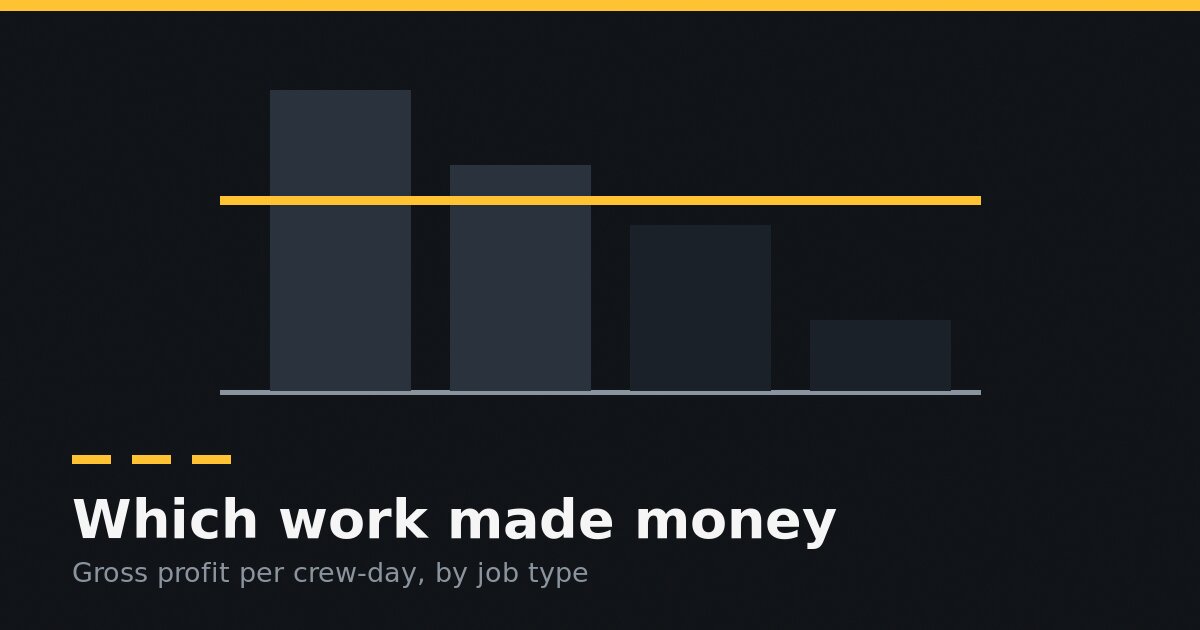
Then group the jobs by type: new construction, overlays, mill and fill, patching, sealcoat, concrete, striping. Look at the margin by type, not the total. The total tells you whether you survived. The breakdown tells you why. It's common to find one type of work carried the year while another lost money on job after job, priced off unit prices nobody had looked at in three seasons.
Look at yield while you're in there: tons ticketed against tons estimated, by type. That number goes straight into next year's waste factor.
3. Rebuild your prices from the actuals
Now change the numbers. If mill and fill ran 12 percent over on labor all year, the labor on your mill-and-fill price is wrong. If your sealcoat coverage came in at 65 square feet per gallon and you priced 75, the material line is wrong. Fix the price, not the estimator.
Call the plant for next year's pricing, or at least which direction it's going. Call the fuel supplier. Get the subs' rates for striping and trucking, and check the expiration dates on their insurance certificates while you're at it, because a certificate that lapses mid-season is easy to miss. Update your equipment costs to this year's actual repair and fuel bills, not what you guessed last winter.
Then decide on margin by type of work. Some work is worth doing for less because it keeps the crew busy in April. Some isn't worth doing at any price you can actually win. Work out the margin each type has to carry from your own overhead and your own numbers, and write it down so the estimator isn't rearguing it on every estimate in June.
4. Look at the crews honestly
Who's coming back? Who should? The off-season is when the good operator you've been meaning to promote goes to a competitor who called first. Make those calls before they do.
Then look at the labor numbers. If one crew kept beating the estimate and another kept missing it, that's not a mystery to solve in May. Find out why now. It's usually equipment, a foreman, or the wrong kind of work for that crew, and all three are fixable in the winter.
If you still track crew hours on paper, this is the winter to stop. Labor is one of the biggest costs on every job, and paper is the least reliable way to know it.
5. Equipment: fix it, sell it or plan for it
Every machine gets its winter service, and the list of what's wrong with each one is in the operator's head. Get it out of their head and onto paper. Then decide: repair it, replace it, or run it one more season and price the risk.
The paver and rollers are obvious. Look harder at the small stuff: the sealcoat rig, the crack machine, the plate compactors, the trucks. A truck that's down for two days in July can easily cost more in lost paving than fixing it in January would have.
6. Sell the spring now
The phone is slower, not silent. Many property managers build next year's budgets in the fall and winter, and the contractor who sends a proposal in December for spring work gets into that budget. The one who calls in April hears the money's already spent.
Go through the season's proposals that didn't close. Some lost on price and aren't coming back. Some just never happened, and a call now with a price good through April is an easy yes. Check the customers you paved for two and three years ago, too. The ones due for sealcoat and striping don't know it yet.
If you write down why you lost each one, this is what that list is for.
7. Fix what broke in July
Every season has a week where everything breaks: the schedule, the change orders, the invoicing, the material orders. In the moment you patch it and keep paving. In January you can fix it.
Make a short list of what actually went wrong. Change orders that got done without a signature. Invoices that went out with the wrong quantities because someone retyped them. A crew that showed up at a lot the customer thought was next week. Each of those is a process problem, and process problems get solved in the office in winter or not at all.
The test for any fix is whether the number gets typed once. If the tons live on the estimate, the work order and the invoice as three separate numbers, they'll disagree by August.
8. Set a target for next year, by type
Last one. Take the job cost numbers from step 2, the prices from step 3 and the crew capacity from step 4, and set a revenue and margin target for each kind of work. Not one company-wide number. A number per type, so in July you can tell whether overlays are on plan or whether sealcoat is carrying the year again.
Then check it monthly once the season starts. Most contractors set a goal in January and look at it again the next January. The ones who look in June still have time to do something about it.
Where Pavr fits
Pavr is job management software for paving, sealcoating, striping and concrete contractors. In Pavr, closed jobs roll up by month, by customer, and by paving, concrete, sealcoat and striping, with each job's actual cost next to what you estimated and its profit against the target you set. That's most of step 2 without the spreadsheet, and the numbers you need for step 8.
Update your plant prices and crew rates once. New estimates use the new numbers, drafts take them when you say so, and proposals you've already sent keep the price the customer saw. A job you lost keeps the reason you lost it, ready for the December calls. Signed change orders go on the job's invoice, and the final invoice can't go out with the punch list still open. Subs' insurance certificates are tracked with their expiration dates. See how profit tracking works.
Was this useful?
It tells us what to write more of.