Sunday night the forecast says 60 percent chance of rain Tuesday, clearing by noon. You've got a 300-ton overlay booked Tuesday, a driveway and a small lot Wednesday, and a mill and fill Thursday with the milling sub already confirmed. The plant wants Tuesday's order by 2 p.m. Monday. The property manager for Tuesday's lot has already emailed the tenants.
What you decide Monday afternoon, and how you move everything after it, is the difference between losing a day and losing the week.
How to handle rain days without losing the week
Handle rain days with three habits. Make the call by a set time the day before, tied to the plant's order cutoff, and check again before the crew leaves the yard. When a day rains out, move that whole day's work to the next workable day and slide everything behind it, instead of squeezing jobs into gaps. And book each month with rain days already in it, so a wet week bends the schedule instead of breaking it.
Make the call on a clock, not a feeling
Most of the money on a rain day is lost by deciding late. Pick the times and stick to them.
The day before, at the plant's cutoff. If the plant needs orders by 2 p.m., that's your first decision. Look at the hourly forecast for the lot's town, not the regional one. Ask two questions: will it rain during the hours you'll pave, and will the base be wet when you start? A shower that clears by 9 a.m. can still leave standing water in the low spots of an old lot until noon.
The morning of, before anyone leaves the yard. Check once more at 5 a.m. If it's a go, it's a go. If it's not, the trucks and the crew hear it before they roll. Put the time of that call in the plan you send the crew the night before, so nobody drives in wondering.
One person decides. The foreman, the owner or the scheduler, but one. Three people looking at three weather apps is how a crew ends up at the lot while the trucks stay at the plant.
The limits you're deciding against are the same every time. Hot mix needs a dry base and no rain, and most specs set a minimum temperature for the surface course. Sealcoat and striping need dry pavement and a dry window afterward long enough to cure. Concrete has its own rules for rain on a fresh finish. Rain days: when to call off the pour or the paving goes through each trade, and your spec or product sheet wins over any rule of thumb.
What a rained-out morning costs
Calling it at 5 a.m. is cheap. Calling it at 8 a.m. at the lot isn't. Here's an illustrative morning where the rain came in after everybody showed up.
Say your crew of seven costs $48 an hour each, loaded, and they're paid for two hours before you send them home. Your four trucking subs charge a two-hour minimum at $105 an hour.
- Crew: 7 × 2 hours × $48 = $672
- Trucks: 4 × 2 hours × $105 = $840
- Total: $1,512, with nothing paved
If the plant already loaded the first trucks, that mix is probably yours too. Some states also require reporting pay for workers sent home soon after they show up, so check your state's rules before you make a habit of sending people home. The cheapest rain day is the one you called the afternoon before.
Move the day, not the jobs
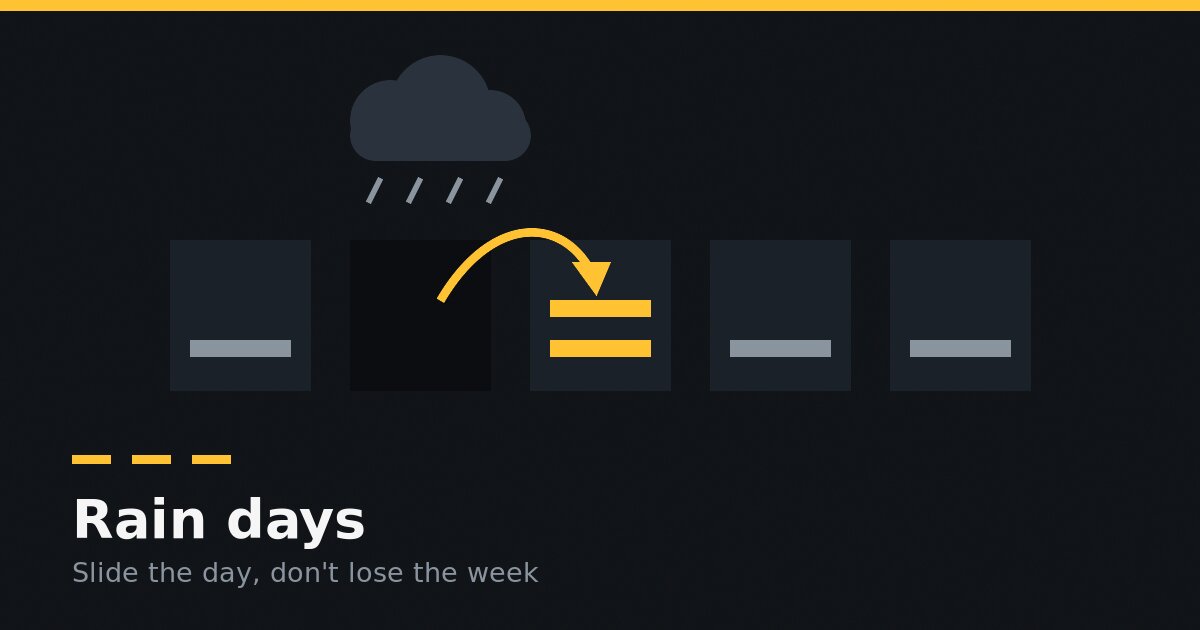
When Tuesday rains out, the tempting move is to find a hole for Tuesday's overlay. Maybe Friday, since Friday's job is small. Then Friday's job goes to next Monday, the Monday job's customer can't do Monday, and by Wednesday nobody is sure which crew is where.
The cleaner move is to slide the day. Tuesday's work goes to Wednesday, Wednesday's to Thursday, and so on to the end of the week. Every crew keeps its jobs in the same order. Every customer moves exactly one workable day. The message to each one is the same sentence with a new date.
Three kinds of jobs don't slide cleanly, so check them first:
Jobs with a hard date. The school lot that has to be done before classes start, the church lot that can't be closed on Sunday. Pull these out and place them by hand before sliding the rest.
Jobs that depend on a sub. If Thursday's mill and fill slides to Friday, the milling sub has to slide too. Call them before you tell the customer, because their calendar may not have Friday.
Jobs that are half done. Don't mill a lot Monday if Tuesday's paving is a coin flip. A milled lot that sits through a rainstorm has loose millings, ponding and a property manager fielding calls from tenants. If the forecast for the paving day is shaky, hold the milling with it.
Plan the month with the rain already in it
A schedule with every workday booked has no room for weather, so the first rain day pushes the whole month. Build in the slack from your own history.
Pull last year's daily logs for June and count the days you lost to weather. Say June has 22 weekdays and you lost 4. Then book about 18 days of paving, not 22. If the weather's good, the backlog moves up and you finish early, which no customer has ever complained about.
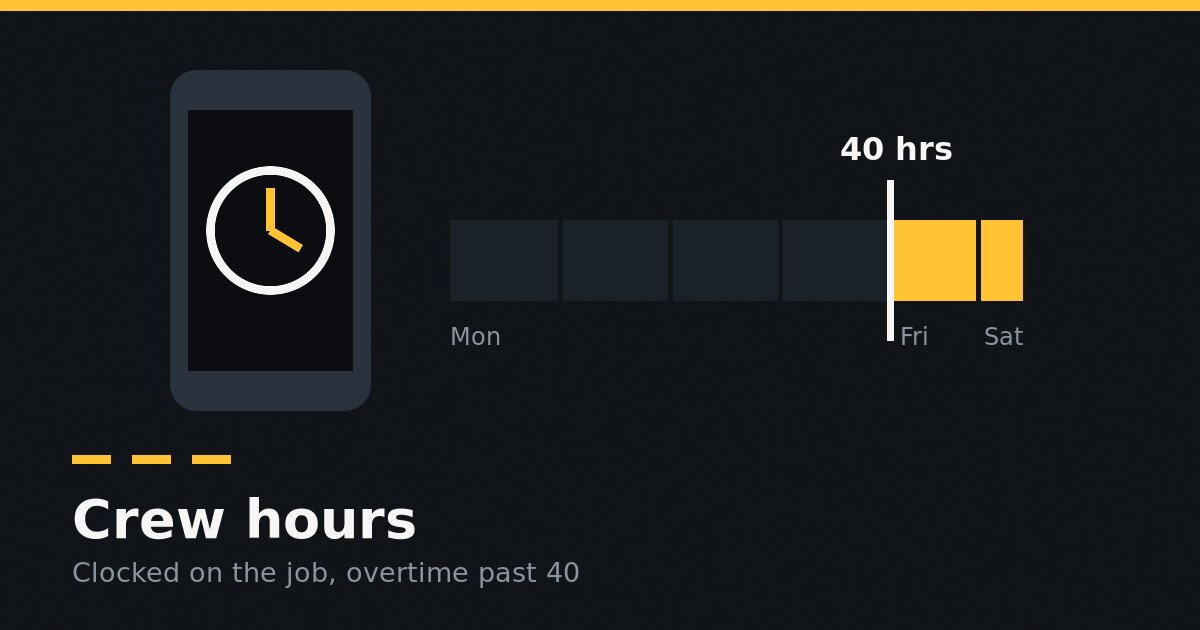
Saturday is your makeup day, and it's often not overtime. Overtime is figured on hours in the workweek, not on the day. If a crew that normally works five 8-hour days loses Tuesday to rain, they're at 32 hours on Friday night, and an 8-hour Saturday brings them to 40, all at straight time. A crew on 10-hour days is already at 40 by Friday even with Tuesday gone, so their Saturday is overtime. Tell the crew in spring that a rained-out weekday may mean a Saturday, so it isn't a surprise in June.
Tell the customer before they plan around you
Nobody blames you for rain. They blame you for finding out when the crew doesn't show.
Send the message at the same time you call the plant, and put the new date in it: "Tuesday's forecast isn't dry enough to pave. We've moved your lot to Wednesday, same start time. We'll confirm Tuesday afternoon." A property manager can forward that to tenants without editing it.
Put the rule in the proposal before the job is signed. One line saying work depends on weather and ground conditions, and that you'll reschedule to the next suitable day, saves a lot of arguing later. If a rain delay changes the job itself, like base repair that has to be redone after a washout, that's extra work and it gets written up as a change order before anyone does it.
What to do with a wet day
If you pay the crew for the day anyway, use it.
Fix what's been limping along. The roller nozzle that's been dripping, the conveyor chain, the trailer lights. A rain day in the yard is cheaper than a breakdown on a dry day.
Walk lots in the rain. It's the best day of the year to see drainage. Ponding, the low corner by the dumpster, the water running under the curb: it's all right there. Take photos for the proposals you're writing, because "the water sits here" is easier to sell with a picture of it sitting there.
Catch up the paperwork. Close out the punch lists and get invoices out on the jobs that are done.
Questions contractors ask
When should I call a rain day for paving?
Make the first call by the plant's order cutoff the day before, using the hourly forecast for the lot's town. Check once more before the crew leaves the yard, and have one person make the final call.
Do I have to pay the crew when it rains?
Hours worked are paid, including time at the yard before you call it. Some states also require reporting pay when an employee shows up and is sent home early, so check your state's labor department rules.
What's the best way to reschedule after a rain day?
Slide the whole day's work to the next workable day and move everything behind it in order. Place hard-date jobs and jobs that depend on a sub by hand first.
Can we pave right after it stops raining?
Only when the base is dry, with no standing water, and the temperature meets the spec. Low spots on an old lot can hold water for hours after the rain stops, so look before the first truck is loaded.
Where Pavr fits
Pavr is job management software for paving, sealcoating, striping and concrete contractors. Every account starts with a weather rule per trade: asphalt, sealcoat and striping need 50°F and no rain, concrete needs 40°F, and you can change them to match your specs. The forecast flags the jobs that won't make it, and a rained-out day moves as one batch to the next day that passes. A crew or a roller booked in two places shows up before dispatch, and dispatch buzzes the foreman's phone.
Was this useful?
It tells us what to write more of.