At 7:15 on a Tuesday the milling machine opens up the entrance at Oak Ridge Commons, and the base under it is mud. The proposal allowed 1,200 square feet of base repair. The foreman paints the soft area and it's closer to 1,650, and near the storm drain it goes deeper than 12 inches. The property manager is on the phone from another property and says, "Just take care of it."
That's the moment a change order is for. What happens in the next hour decides whether that work gets paid for in September or argued about in October.
What change orders on paving jobs are for
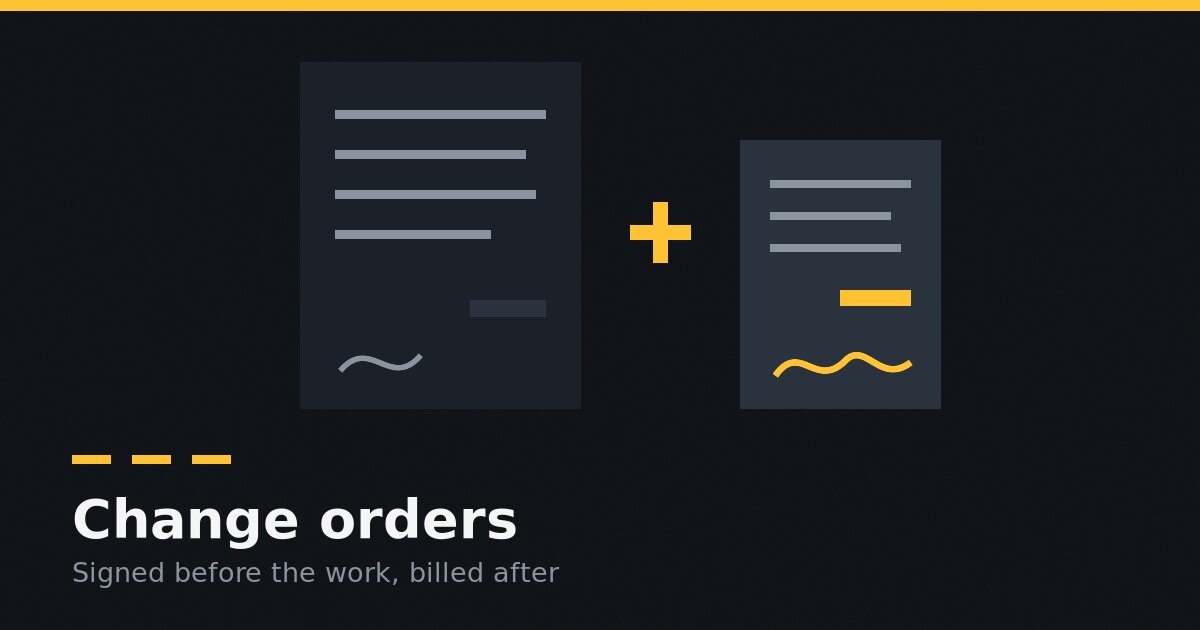
A change order is a written change to the work, the price or the schedule, signed by the customer before the crew does the changed work. It says what's different, what it costs and how it moves the finish date. Once it's signed, it goes on the invoice like any other line the customer agreed to.
There are two ways to lose money on a change. You do the work before anyone signs, and the price becomes a negotiation after the fact. Or you get the signature and the extra work never makes it onto the bill. Both are fixable, and neither one is about paperwork for its own sake.
The usual reasons on a lot
Paving change orders come from a short list:
- Soft base under the mill. The one you can plan for, with a unit price on the proposal.
- The customer adds work. The back lot, the loading dock apron, sealcoat on the side lot "while you're here."
- A different layout. More accessible stalls, a new fire lane, arrows that go the other way.
- Conditions the walk couldn't show. A drain structure that has to be rebuilt, a buried slab, a milling depth that finds concrete.
- A return trip the customer caused. The lot wasn't clear, or the gate was locked, and the crew had to leave and come back.
Weather usually isn't on it. A rain day is your risk unless the contract says otherwise. A lot full of tenants' cars on the morning you were told it would be empty is theirs, and that belongs on a change order for the return trip.
Price it the way you priced the job
The customer signed a proposal built from your costs plus your markup. Build the change the same way, so the price has the same logic as the one they already accepted.
When the proposal has a unit price, use it. The paving proposal for Oak Ridge said additional base repair is $9.50 per square foot, up to 12 inches deep. The extra 450 square feet is 450 × $9.50 = $4,275. That change order takes a minute to write and nobody argues with it, because they agreed to the price in May.
When it's new work, build it from cost. The 400 square feet near the drain needs another 12 inches of undercut below what the unit price covers. Say it comes out like this:
- Extra excavation, trucking and dump fees: $780
- Stone: 400 sq ft × 1 ft deep is 400 cubic feet. At an assumed 135 lb per cubic foot compacted, that's 54,000 lb, or 27 tons, at $22 a ton: $594
- Crew, 4 more hours at $385 an hour: $1,540
- Excavator and skid steer, 4 hours at $165 an hour: $660
- Cost: $3,574
The proposal carried a 20 percent markup on cost, so the change order does too: $3,574 × 1.20 = $4,288.80. Use your own stone weight and your own rates. The point is that the customer sees quantities and a price that were built the way their proposal was.
Price the time as well as the material. If the change adds a day, say so, and say what that day costs. If the crew has to leave and come back for it, price the return trip.
Get the signature before the crew touches it
This is where good change orders turn into arguments. The crew is on the lot, the machine is running, and every hour spent waiting for a signature costs money too. So the foreman does the work and the office sorts it out later.
The way out is speed, not skipping the step. Write the change order while the foreman is still standing at the soft spot, with the photos attached, and get it to the person who can approve it. If they can sign on their phone from an email, most of the wait disappears.
If they can't sign right away, keep the crew working on the parts of the lot the change doesn't touch. Pave around the soft area and come back to it. It's better than guessing, and a lot better than an unsigned "just take care of it." A text that says "go ahead" is better than nothing, but it isn't a signature on a price. Answer it with the written change order anyway, and ask for the signature before the extra stone goes down.
What goes on the page
A paving change order doesn't need to be long. It needs to be complete:
- The job and the date of the original proposal
- What's changing, in the same plain words as the proposal: where, how much, how deep
- The photos, numbered
- The price, and how it was figured: a unit price times a quantity, or the cost lines
- How it changes the schedule, if it does
- A line saying everything else in the original proposal stays the same
- A place to sign and a date
Number them. "Change order 2" is easier to find in a stack of email than "the drain thing."
For more on the kinds of changes and how to talk about them with the customer, see the change orders guide.
Then bill it
A signed change order sitting in an email folder is still unpaid work. The final invoice should show the original contract, each change order by number, and the new total, so the customer can match every line to something they signed:
- Original contract: $84,050.00
- Change order 1, additional base repair, 450 sq ft: $4,275.00
- Change order 2, undercut at the storm drain: $4,288.80
- Revised contract: $92,613.80
Check it once more before it goes out: every signed change order is on the invoice, and nothing on the invoice is missing a signature. That second check matters as much as the first. A line the customer didn't sign is the one that holds up the whole payment.
If the job bills monthly against a schedule of values, the signed change order goes on as its own line. It gets billed as it's done, like everything else.
Where Pavr fits
Pavr is job management software for paving, sealcoating, striping and concrete contractors. Outline the extra work on the job's map, price it, and send it with the photos attached. The customer gets it by email and signs on their phone. It's priced at the margin they signed on the proposal. The part of the job it touches waits for that signature. Once it's signed, it's on the invoice, or on the schedule of values as its own line. See how signing works.
Questions contractors ask
Is a rain day a change order?
Usually not. Weather is normally the contractor's risk unless the contract says otherwise. A delay the customer causes, like a lot that isn't cleared, is a different story, and the return trip belongs on a change order.
Can I charge markup on a change order?
Yes. Use the same markup the original proposal carried, so the price follows the same logic the customer already accepted. On GC work, check the subcontract, because some set the markup allowed on changes.
What if the customer won't sign the change order?
Don't do the changed work. Finish what the original proposal covers, write down what you found with photos, and tell the customer in writing what the lot needs and what it costs.
Should small changes get a change order too?
Yes. A $300 change without a signature is where the habit of skipping the signature starts, and the next one is $6,000.
Was this useful?
It tells us what to write more of.