Why the check is smaller than the invoice
You finished the paving on a new retail center and billed $180,000. The check that came was $162,000. Nothing's wrong. That's retainage. The general contractor is holding 10 percent until the whole project is done and accepted, and they'll hold it as long as the project takes, which might be six months after your crew left.
If you only do residential driveways, you can skip this. If you do commercial lots, municipal streets or anything for a GC, this is how you get paid, and you need to price for it, bill for it and track it.
Progress billing: getting paid as the work gets done
On a job that runs weeks or months, you don't bill once at the end. You bill for the work completed at set intervals, usually monthly. The owner or GC reviews it, approves the amount they agree is done, and pays that, less retainage.
The tool for this is a schedule of values. Before the job starts, you break the contract price into lines like mobilization, base prep, milling, binder, surface and striping, each with a dollar value. The lines add up to the contract price. Every month you report how much of each line is complete, and the bill follows from that.
A simple one for a $180,000 lot might look like this:
- Mobilization and traffic control: $8,000
- Milling and transport: $22,000
- Base repair: $15,000
- Binder course: $60,000
- Surface course: $55,000
- Striping and signage: $12,000
- Closeout and punch list: $8,000
At the end of month one, you're mobilized, milling is done and base repair is halfway. You bill $8,000 + $22,000 + $7,500 = $37,500. Less 10 percent retainage, you receive $33,750. Next month you bill the next chunk of completed work, and so on.
Two things matter here. Give mobilization and early work their real cost, so you aren't financing the GC's project. And don't overstate percent complete. The GC's superintendent walks the site, and once they catch you claiming 80 percent on a binder course that's half done, every pay app after that gets picked apart.
The AIA forms
On a lot of commercial work, the pay app goes on AIA G702 (the application and certificate for payment, a one-page summary) with a G703 continuation sheet behind it. The G703 lists each line with its scheduled value, work completed in previous periods, work completed this period, materials stored, total completed and stored to date, percent complete, balance to finish, and retainage. GCs see these all day, and a pay app in the format they expect gets approved with fewer questions.
Public work often has its own forms carrying the same information. State DOT jobs are usually measured and paid by the unit, which is a different world.
Retainage: what it is and what it costs you
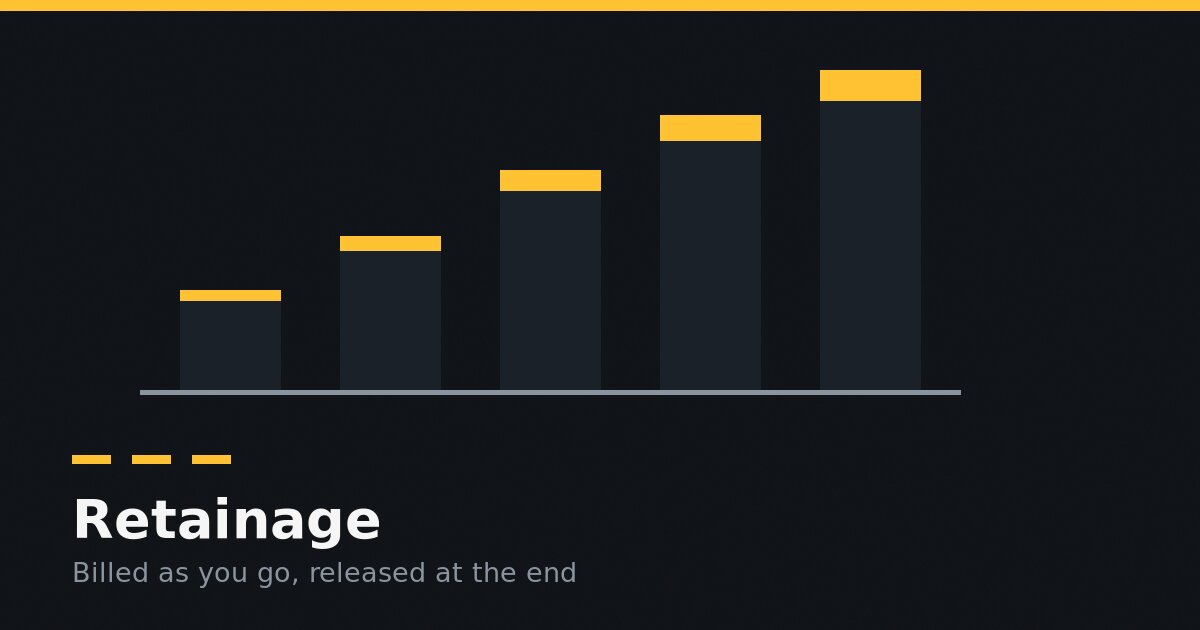
Retainage is a percentage held back from every progress payment as security that you'll finish the work and the punch list. Ten percent is common. Plenty of contracts drop it to 5 percent or less once the job is half done, and many states cap it on public work. The owner holds it until substantial completion or final acceptance, then releases it, sometimes in two steps.
Here's what that means in cash. On the $180,000 lot, $18,000 sits with the GC for the whole project. Say you priced the job to make $36,000 over your direct costs. Half of it is on hold. If final acceptance is nine months out, you're carrying that money through a winter.
So price for it. Retainage isn't a cost, but the wait is. Figure what $18,000 costs you for nine months on your line of credit, and either put that in the price or make sure the job's numbers survive the wait. Either way, know the retainage terms before you sign, and know when the money comes back.
Read the subcontract before you sign
The subcontract tells you the retainage percentage, whether it steps down, what triggers release, and whether the GC can hold your retainage until the owner releases theirs. Watch for that last one, along with the payment clauses. Under pay-when-paid, the GC pays you within a set time after the owner pays them. Under pay-if-paid, the GC can argue that if the owner never pays, they never owe you. Many states restrict pay-if-paid clauses, so know what yours allows.
Also look at what counts as completion. If retainage is released at "final acceptance of the project" and your paving was done in month two of a twelve-month build, you wait ten months. Ask for release at completion of your own work. You won't always get it, but you'll never get it if you don't ask.
Tracking it
This is where retainage goes wrong for a lot of contractors. They know it's owed, but they lose track of how much, on which jobs, and when it comes due. Then the GC's project closes, somebody moves on, and nobody asks about the $18,000.
Keep a retainage record for every job: contract amount, retainage percent, amount withheld to date, amount released, balance outstanding, and what triggers release. When a job hits substantial completion, put a reminder on the calendar to request release. When the GC's project closes, put in another one.
It works the other way with your subs. If you hold retainage on the striping sub, check your state's prompt payment rules. Many states require you to pass retainage along within a set number of days after you receive yours.
The punch list is the release key
Retainage is security for completion, and completion means the punch list is closed. On a paving job the list is usually short: a low spot near a drain, a raveled joint, a stall line that's off, a manhole that needs adjusting. Walk it with the super, fix it fast, get it signed off, and send the retainage release request with the sign-off attached. The job isn't done when the roller leaves. It's done when the retainage clears.
Where Pavr fits
Pavr is job management software for paving, sealcoating, striping and concrete contractors. In Pavr the schedule of values is built from the lines the customer signed, and a signed change order goes on as its own line. Each month you enter the percent complete on each line, and the pay application bills what was done since the last one, holds back the retainage, and prints a continuation sheet in the G703 layout for the GC. The job keeps a running record of what's been withheld, what's been released and what's still owed.
The final invoice can't go out while the punch list is open. Once the punch list milestone is billed and the hold period has passed, the retainage is ready to release, and you send the release bill from the job. Invoices go to QuickBooks Online, and payments recorded there come back to the job.
Was this useful?
It tells us what to write more of.