The last roller leaves the Riverside Commons retail lot on a Friday in October. The striping crew was there Thursday. The foreman texts a photo of the finished lot and moves on to the next job.
For the crew, the job is over. For the office, the part that gets you paid in full is just starting, and it's the part that's easiest to let slide. By the time the last pay app goes in, the GC will be holding $14,840 of your money, and nobody is going to call to remind you.
What closing out a paving job means
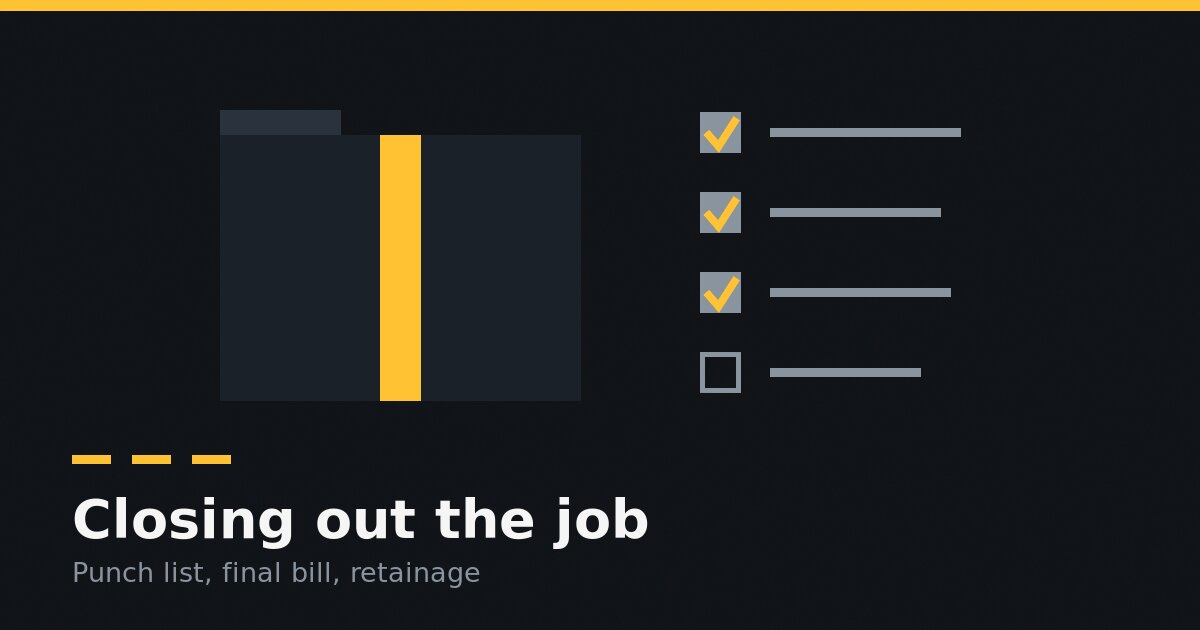
Closing out a paving job is the office work between the crew's last day and the last dollar. The punch list gets walked and signed off. The final invoice or pay app gets built from the signed contract and change orders, subs and suppliers get paid and their waivers collected, and retainage gets requested in writing. Then you put what the job cost next to what you estimated, while you still remember why they differ.
On a small private lot, that can all happen in an afternoon. On a GC job, it can stretch across months. Either way, it's the same list.
Walk the punch list with whoever signs off
Walk the lot with the person who can accept the work: the property manager, the owner's representative, or the GC's superintendent. Write each item down where it is, with a photo:
- A low spot holding water near a catch basin
- A raveled joint at the entrance
- A stall line that's off
- A manhole or valve box that sits proud of the new mat
- Tack or overspray on a curb or a building
Agree on the list before anyone leaves. That list is the punch list. Anything that turns up later is a warranty call or a new conversation, not a reason to hold the final payment.
Fix the items quickly and photograph each one done. Then get the sign-off in writing. On a GC job, ask whether the GC also wants a signed certificate of substantial completion, such as AIA's G704, for your part of the work. It's often the document that starts the retainage clock.
Build the final bill from what was signed
Start from the contract and add every signed change order, and nothing else. On a direct job, take off any deposit. On a GC job, the last pay app picks up whatever hasn't been billed yet.
Take the Riverside Commons lot. Say your subcontract was $142,000, and the GC's change order for $6,400 of extra base repair finally came through in October, once the owner approved it. The revised contract is $148,400. Two earlier pay apps billed $85,500 in June and $53,500 in October, which is $139,000.
The final pay app bills what's left:
- Punch list and cleanup: $3,000
- Change order 1, base repair: $6,400
- This pay app: $9,400
- Retainage at 10 percent: $940
- Due now: $8,460
The retainage held across all three pay apps is $8,550 + $5,350 + $940 = $14,840. That's 10 percent of $148,400. Check that your number matches the GC's number now, not in April.
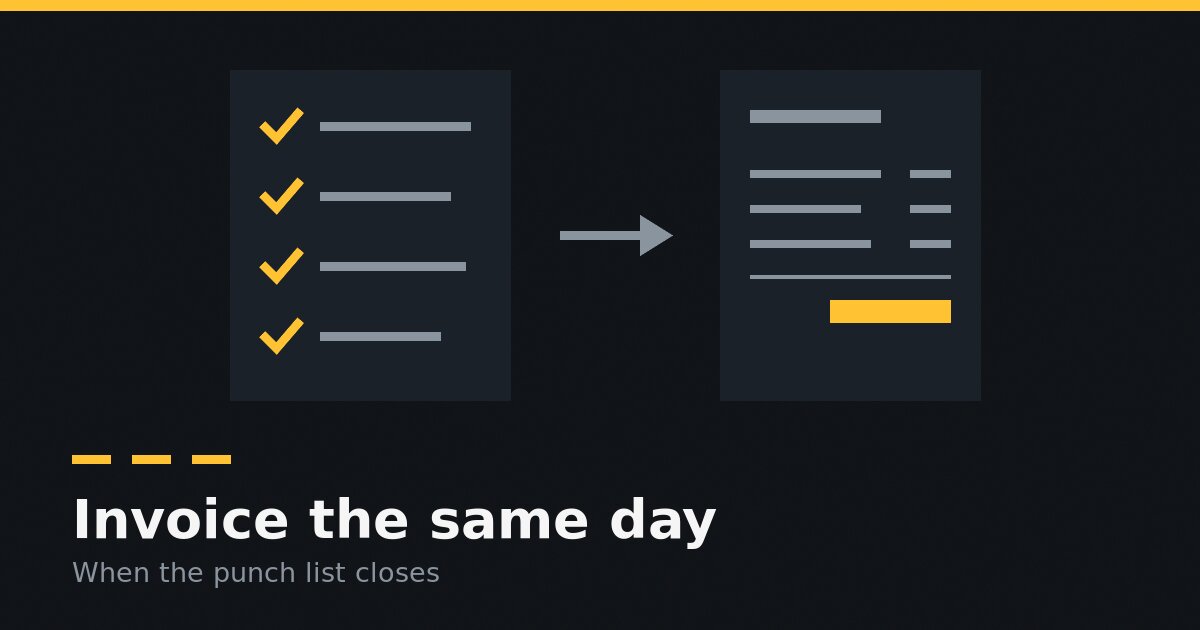
Before it goes out, check the other direction too: every line on the bill traces to a signature. For a direct job, where the invoice goes to the customer the day the punch list closes, see invoice the day the punch list closes.
The paperwork the GC or owner will ask for
Collect it before they ask. A closeout package that arrives complete gets processed. One that arrives in pieces gets put in a pile.
- Your final lien waiver, conditional on the final payment. Send the unconditional one only after the money has cleared.
- Final waivers from your subs and suppliers, if the contract calls for them. The striping sub and the plant may both have lien rights.
- A warranty letter stating what you warrant, from what date, and for how long, if your contract includes one.
- Test reports, such as density tests, if the spec required them.
- Final quantities, on a unit-price job.
- A current certificate of insurance, if yours renewed during the job.
The subcontract lists what's required. Read that section again now, because it's easy to forget a requirement signed back in March. Working for a GC covers how waivers and pay apps work along the way.
Pay your subs and settle the material
Closeout goes both ways. Pay the striping sub, the trucking company and anyone else on the job, collect their final waivers, and close out anything still open on the job.
Then reconcile the plant. Add up the tickets for the job, match them against the plant's statement, and chase any ticket that landed on the wrong job. It's easier to fix a charge the week after the job than at year end.
Ask for retainage in writing
Retainage doesn't come back because you earned it. It comes back because someone asked at the right time, with the right paperwork.
When the release condition in your contract is met, whether that's completion of your work, substantial completion of the project or final acceptance, send a written request. Include the amount, the contract section that triggers release, the punch list sign-off and the closeout documents. Then put two dates on the calendar: when you'll follow up, and when the project's own closeout should trigger release if yours didn't.
For how retainage steps down and what the wait costs, see retainage and progress billing.
Put the estimate next to the job
Before the file goes in the drawer, compare what the job cost against what you estimated, line by line. Tons placed against tons estimated. Crew hours against the estimate. The sub's final invoice against the sub's quote. The base repair change order against its cost.
Write one sentence about what you learned. "Binder ran 9 percent over at the entrance because the grade was lower than the plan showed" is a note that fixes your next estimate on a site like it. Job costing for paving contractors covers how to read those numbers during the job, not only after.
File it so you can find it
Put everything in one place: the signed contract and change orders, pay apps, waivers, photos, daily logs, the punch list sign-off and the warranty letter. A year from now, when someone calls about a crack near the drain, you'll want the photo of that drain on the day you finished.
Put the warranty end date on the calendar too, with a reminder a month before. A walk of the lot before the warranty runs out is a chance to fix small things on your terms and to price the next sealcoat.
Where Pavr fits
Pavr is job management software for paving, sealcoating, striping and concrete contractors. The final invoice can't go out while the punch list is open. The customer walks the punch list on their phone, item by item with the crew's photos, and signs off. The invoice comes off the signed proposal plus every signed change order, and on a bigger job, the pay app holds retainage from the first application until the release bill once the job is closed out. The job's costs sit next to the estimate, line by line, and closed jobs roll up by month, by customer and by trade.
Questions contractors ask
When does retainage get released on a paving job?
When the release condition in your contract is met. That might be completion of your work, substantial completion of the project, or final acceptance, sometimes in steps. Read the clause before you sign, and ask for release in writing once the condition is met.
What's the difference between substantial completion and final completion?
Substantial completion generally means the work is done enough to be used for its purpose, with only punch list items left. Final completion means the punch list is done too. Your contract defines both, and it's the contract's definition that counts.
Do I need a warranty letter at closeout?
If your contract or the GC's closeout list asks for one, yes. Even if nobody asks, writing down what you warrant and for how long heads off arguments later.
How long should I keep closeout records?
Ask your accountant and your attorney, since tax rules, warranty periods and lien deadlines all affect the answer. Keeping the signed documents and photos for the life of the warranty is the minimum.
Was this useful?
It tells us what to write more of.