It's the first week of October. Open invoices add up to $212,000, which looks fine until you sort them. The plant wants its September statement paid. In six weeks the crews go on layoff and the money stops coming in until April, but the equipment payments, the insurance and the shop lights don't stop with it.
Every contractor has a customer who pays slowly. The difference in October is that the season to fix it is almost over. A customer who owes you now owes you a lot less urgently in January.
How to collect past-due invoices before winter
Work the list every week in October. Sort the open invoices by age and by the reason they're unpaid, fix anything that's holding them up on your side, and call about everything more than 30 days late with a specific question. Send statements, stop new work for customers who are 30 days late, and check your lien deadlines before they pass. Past-due invoices get harder to collect the longer they sit, so the order you do this in matters less than starting this week.
Sort the list by age, then by why
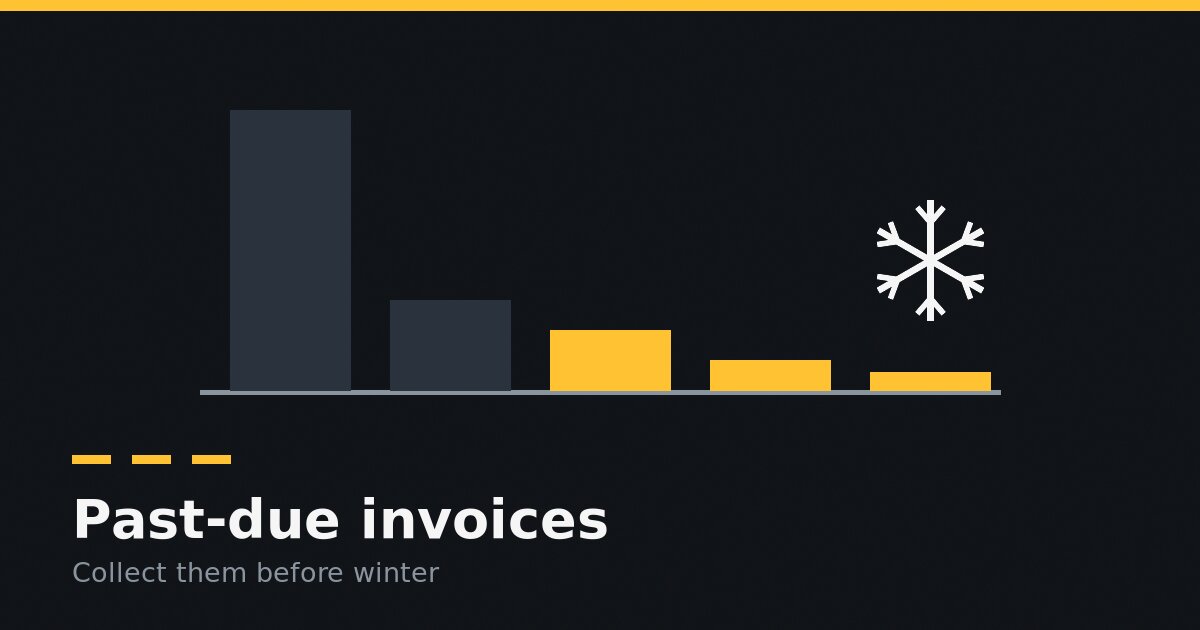
Run an aging report and put the numbers in buckets:
| Age | Amount |
|---|---|
| Current | $148,000 |
| 1 to 30 days late | $36,500 |
| 31 to 60 days late | $19,200 |
| 61 to 90 days late | $6,100 |
| Over 90 days | $2,200 |
| Total | $212,000 |
The first two rows are normal. The last three, $27,500, are the October project.
Now go through that $27,500 invoice by invoice and write down why each one is unpaid. The reasons fall into a few groups, and each group needs a different call:
- They never got it, or it went to the wrong person.
- Something's missing on their end: a PO number, a W-9, a lien waiver, the punch list sign-off.
- They dispute part of it.
- They're slow and they know it.
- They can't pay.
Fix what's on your side first
Some past-due invoices aren't late because of the customer. The property manager approved it, but accounts payable rejected it because the PO number was missing, and nobody told you. The invoice went to someone who left the company in July.
Find these first. They're the fastest money on the list. Call accounts payable directly and ask: "Do you have invoice 1047 for $6,100? Is there anything you need from us to pay it?" If they need a form, send it that day. Then resend the invoice to the right address, and write down who you talked to.
Make the call with a question, not a complaint
A past-due call goes better when you've got a specific question and a note of what you'll do next. Something like:
"I'm calling about invoice 1052 for the sealcoat at Parkview, $4,800, which was due September 4. Can you tell me when it's scheduled to be paid?"
Then listen. If they give you a date, write it down and repeat it back. If they say it's approved and waiting for a check run, ask when the next one is. If there's a problem, you want to hear it now, not at 90 days.
Follow every call with a short email that says what was agreed: "Thanks for confirming invoice 1052 will go out in your October 15 check run." It's polite, and it's the record you'll need if the date slides.
Statements, reminders and late fees
Send a statement to any customer with more than one open invoice. Seeing the whole balance on one page makes it real in a way three separate reminders don't.
Send reminders on a schedule, so nobody in your office has to decide whether it's time to ask. A reminder at 7, 14 and 30 days past due is firm without being rude.
Charge late fees only if your terms allow them. The proposal or invoice terms have to say so before the work, and your state may limit how much you can charge. A late fee you can waive when a customer pays quickly is a good tool for starting a conversation.
Stop the next job
The strongest collection tool you have is the next piece of work. A customer who's 30 days late shouldn't get another lot scheduled or another proposal priced until the account is current, or until someone with authority decides to make an exception and writes down why.
Say it plainly: "We'd be glad to get the back lot on the schedule. We just need the Parkview invoice cleared first." A customer who wants the work usually finds the check.
Separate the disputed part from the rest
When a customer disputes one line, don't let it hold up the whole invoice. Ask them to pay the part that isn't in question while you sort out the rest.
Then settle the disputed part with records, not memory. Pull the signed change order, the daily log for that day and the photos. If you were wrong, issue a credit and move on. If you were right, send the documents along with a clear request. Daily logs that back you up covers what those records need to show.
Know your lien deadlines
Mechanic's lien rights don't last. The deadlines are set by your state's lien statute, and they're usually counted from your last day of work or the completion of the project, not from the invoice date. On some jobs, a preliminary notice had to be sent early in the job to protect those rights at all. On public projects you generally can't file a lien, but you may have a claim against the payment bond, and that has its own deadline too.
That's why the October list matters. A job you finished in July may have a lien deadline in the next few weeks. Find the deadline for every job over 60 days late, and talk to a construction attorney before it passes. Don't threaten a lien you haven't checked you can file.
When it's time to hand it off
At some point, the phone calls stop working. Then there are a few options, depending on the amount and how the relationship is going:
- A demand letter from an attorney, which often gets a response a phone call didn't.
- Small claims court, for amounts under your state's limit.
- A collection agency, which keeps a share of what it collects.
- A lien or a bond claim, filed on time, with an attorney's help.
Some invoices won't be collected. Talk to your accountant before the end of the year about writing them off, rather than carrying them as open forever.
Before next season
A lot of collection problems start in the proposal. Terms that say when payment is due, what happens when it's late, and who gets the invoice make October a lot easier. So does sending the invoice right away: invoice the day the punch list closes covers why, and closing out a paving job covers the paperwork that keeps a GC payment from getting stuck.
Where Pavr fits
Pavr is job management software for paving, sealcoating, striping and concrete contractors. Reminders go out at 7, 14 and 30 days past due, each with a Pay button. It goes to your QuickBooks payment page, or to wherever you already take payments, and Pavr takes nothing on it. Turn on Pavr Payments and the customer pays right on the invoice, by bank transfer or card, into a Stripe account in your business's name, for 1% plus Stripe's rates, and a check always works. You can send a customer a statement of everything they have open. Late fees are there if your terms allow them, flat or a percent after a grace period you set, and you can waive one. A customer 30 days past due goes on hold, and nobody schedules new work for them without an Admin saying why. When the customer pays in QuickBooks, the invoice shows paid.
Questions contractors ask
When should I call about a past-due invoice?
Within a few days of the due date, not at 60 days. The first call is usually about a missing PO number or a wrong address, and those are easy to fix early.
Can I charge late fees on past-due invoices?
Only if your proposal or invoice terms said so before the work. Your state may limit the rate or amount, so check before you set it.
Should I file a mechanics lien?
It depends on the amount, the deadline and whether you can file on that job at all. Find the deadline in your state's lien statute and talk to a construction attorney before it passes.
What if the customer pays part of the invoice?
Take it, apply it, and confirm in writing what's still owed and when it's due. A partial payment is progress, not a settlement, unless you agree otherwise.
Was this useful?
It tells us what to write more of.