It's the middle of September. The crews are booked for about five weeks, the mornings are starting to feel different, and the phone is ringing with the same question: "Can you get us in before winter?" The school wants its bus loop done over fall break. A property manager just found money left in this year's budget. A homeowner wants a driveway before the holidays.
Some of those are good jobs. Some are jobs that will cost you in November. Late-season pricing is sorting which is which.
What to book and what to push to spring
Late-season pricing comes down to fitting the right work into the paving days you actually have left. Count those days honestly, book the jobs that need hot mix and warm weather first, price the fall conditions into every proposal, and sell the work that can wait as spring work at a price and a date you set now.
The hardest part is the counting, so start there.
Count the days you really have
Call your plant and ask when it plans to close for the season. The plant sets the date, it moves with the weather, and it isn't the same date every year. Then work backward.
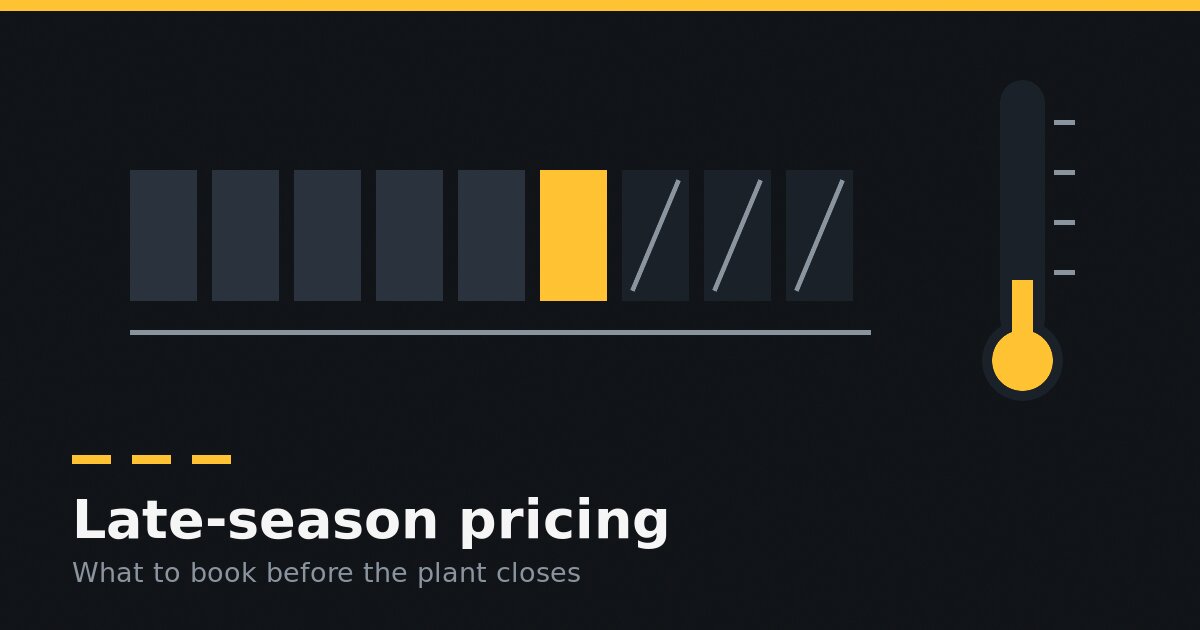
Say the plant expects to close around November 20, and you start counting on Monday, September 21. That's 9 weeks, or 45 weekdays. Then take out what the season takes:
- Rain days. Say you lose about one a week this time of year. That's 9, which leaves 36.
- Cold mornings. Late October and November bring days that don't get warm enough to pave, or warm up too late to get a full day in. Say that costs 6 more. That leaves 30.
- The work you've already booked. Five weeks of backlog is 25 paving days. That leaves 5.
Five open days, not the nine weeks the calendar suggests. Every late-season proposal you send is competing for those five days, and anything you book past them is a promise you'll be trying to keep in the cold.
Use your own history for the rain and the cold. Look at last October's schedule and count the days that actually went.
Rank the work by what can't wait
With five days to sell, not every job deserves one. Put the ones at the top that lose the most by waiting:
Failed base and potholes that will get worse. Water gets into broken pavement, freezes and does more damage over the winter. A patch now may save the customer a bigger repair in spring, and that's an easy case to make.
Paving that needs hot mix. When the plant closes, it's over until spring. Sealcoat and striping have their own temperature limits, and concrete can go on with the right precautions, but hot mix has a hard stop.
Customers with money that disappears. Some organizations have to spend this year's budget by December 31. Their deadline is real, and they'll often sign quickly.
Work that can wait without getting worse. A lot that needs sealcoat but is holding up, a restripe that's faded but readable. These are spring jobs. Sell them now and schedule them in April.
Price the fall into the job
A lot paved in late October isn't the same job as one paved in July, and it shouldn't be the same price.
The mat cools faster. On a cold, windy day, a thin lift loses heat quickly and the compaction window gets short. You may need a second roller, a tighter truck schedule, or a thicker lift than you'd price in summer. Check what your state DOT spec says about minimum temperatures for the lift thickness you're placing, even on private work. It's the standard someone will measure you against.
The days are shorter. Less daylight means fewer tons placed in a day, or lights and overtime. If a job took two days in July, price it for two and a half in late October.
The weather risk is higher. More rain days mean more trips back to the lot with the equipment, and a job that slips can slip right past the plant's closing date.
Here's how that adds up. Say a 2-day summer job carries $6,800 of crew and equipment a day. In late October you add a second roller at $450 a day and price 2.5 days instead of 2. That's 2.5 × ($6,800 + $450) = $18,125, against $13,600 in July. The difference, $4,525, is what late October costs you whether you price it or not.
Put the weather in the proposal
A late-season proposal should say out loud what happens if the season ends first:
If weather or the plant's seasonal closing keeps us from completing the paving by November 20, 2026, the remaining work will be scheduled for spring 2027 at the same price, as long as it's completed by May 31, 2027.
Pick the terms you can live with. You might hold the price, or you might say spring work gets repriced at next season's plant prices. What matters is that the customer agreed to it in September, not that you're explaining it on the phone in December.
For how a rain day moves the rest of the week, see the running the job guide.
Sell spring now
Everything that doesn't fit this fall is next spring's first work, and the customer is paying attention right now.
Send those customers a spring proposal while they're still thinking about the lot. Hold the price to a signing date, and be honest about materials. Your plant will set next year's price over the winter, so either hold the price with a small cushion built in, or say that it'll be confirmed when the plant sets its prices in the spring.
A signed spring job does two things. It gives the crews a starting schedule before the first warm week, and it takes that customer off the market before anyone else calls them in March. If you ask for a deposit to hold a spring date, check your state's rules first, especially for homeowners, since many states limit deposits on residential work. The off-season checklist covers what else belongs in the winter.
The same goes for the property managers budgeting next year right now. Winning repeat work from property managers covers getting into their budget before it's set.
Turn down the job you'll regret
Somewhere around November 10, someone will call with a lot that has to be paved this week, at a price that sounds great. The forecast says 38°F and wind. Your foreman already knows how that job ends: a mat that won't compact, raveling by spring and a callback on your dime.
Say no, or say "first thing in April." The customer who wanted it this week will remember a failed lot longer than a polite no.
Where Pavr fits
Pavr is job management software for paving, sealcoating, striping and concrete contractors. Every account starts with weather rules per trade: asphalt, sealcoat and striping need 50°F and no rain, and concrete needs 40°F. You can change them. The forecast flags the jobs that won't make it, and a rain day moves as one batch to the next day that passes. The Jobs board shows every open job by sales stage, so you can see what's out against what the crews can still pave. A plant price change for next season never moves a proposal you already sent. See how estimating works.
Questions contractors ask
How late in the year can you pave asphalt?
It depends on the mix, the lift thickness, the weather that day and when your plant closes. Many state DOT specs set minimum air and surface temperatures by lift thickness, and they're a sound guide even on private work. Ask your plant when it expects to close.
Can I sealcoat in October?
Only if the product's requirements are met for the whole application and cure. Most manufacturers call for 50°F and rising and a dry stretch afterward. Read the label on the product you're using, and remember that shorter, cooler days slow the cure.
Should I hold this year's prices for spring work?
Only with a cushion, or with a clear statement that material prices will be confirmed in spring. The plant will set next year's price over the winter, and a spring job at last year's price comes out of your margin.
Is it worth taking a deposit on spring work?
It can be, because a deposit makes a spring commitment real. Check your state's limits on deposits first, especially on residential work, and state in the proposal what happens to the deposit if the job moves.
Was this useful?
It tells us what to write more of.