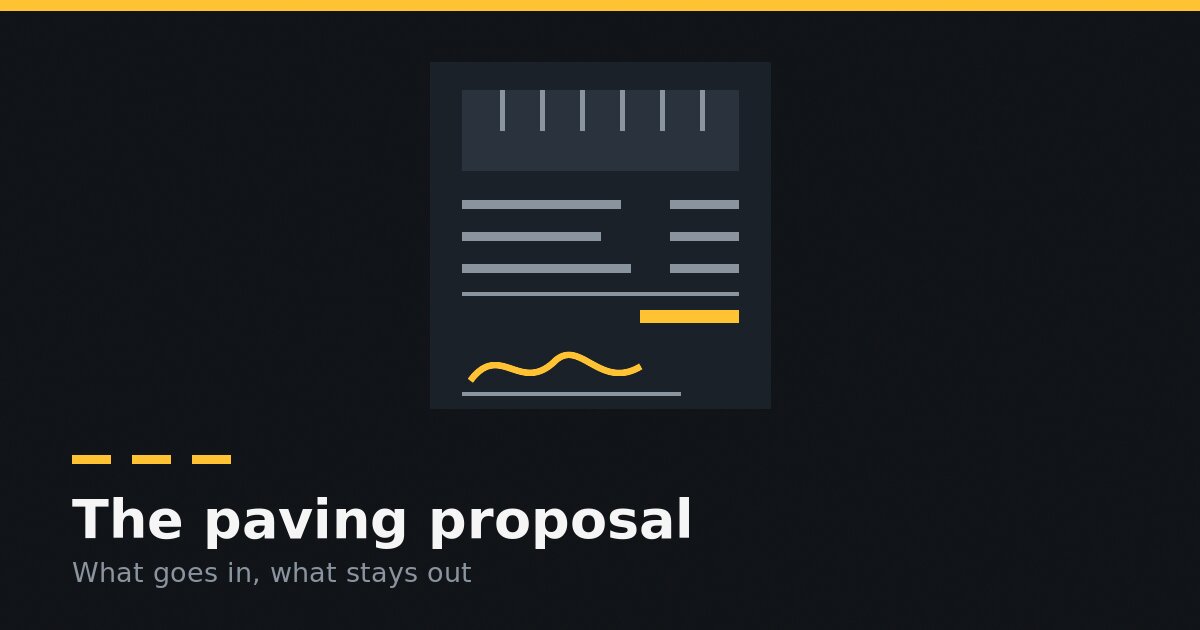
It's 9:40 at night and the Oak Ridge Commons lot is priced. The tons are right, the failed base at the entrance is marked, and the margin is where you want it. Now the number has to become a paving proposal that a property manager reads on a phone between two meetings, forwards to an owner who has never seen the lot, and signs.
That page has two readers. The first is the customer deciding between your proposal and two others. The second is everyone who opens it again in August, when the milling machine finds something nobody expected. Write it for both.
What a paving proposal has to do
A paving proposal customers sign says exactly what you'll do to the lot, in plain words, with the quantities that set the price: square feet, compacted thickness, milling depth, stall count. It names what isn't included, how long the price holds and how extra work gets priced. Your costs, your crew hours and your markup stay on your side of the table.
Everything below is how to get there.
Start with the lot, not your company
Put the property first: its name, the address, who asked for the price and the day you walked it. Then write one or two sentences about what you saw.
The drive lanes have alligator cracking at the main entrance and in front of the dumpster pad. Water stands along the north curb after rain.
That sentence does more selling than a page about your company. It tells the property manager someone actually walked the lot, and it gives the owner a reason for the price before they get to it. Attach three or four photos of the worst spots and number them, so the work can say "see photo 2." If you want a checklist for the walk itself, walking the lot before you price it covers what to measure and photograph.
Write the work as quantities, not adjectives
"Resurface parking lot" is a price with no fence around it. The customer will remember it as more than you meant, and you'll remember it as less. Write what you'll do to the lot the way the crew will build it:
Mill the drive lanes 2 inches deep, about 12,000 square feet, and transport the millings off site. Cut out and replace failed base in the areas marked in photos 1 and 2, up to 1,200 square feet, 12 inches deep, with compacted stone. Tack the milled surface and pave the whole lot, 30,000 square feet, with 2 inches of compacted surface mix. Restripe 84 stalls, 2 accessible stalls with symbols and 6 arrows to match the current layout.
Every number in that paragraph is a promise and a limit at the same time. "Compacted" matters, because 2 inches loose and 2 inches compacted are different amounts of mix, and the owner's engineer knows it. The milling depth matters because it's the first thing anyone argues about when the lot comes up different. "To match the current layout" matters because a layout change is a different job.
Leave shorthand out. HMA, R&R, SC 2x and "fine grade" mean something to you and nothing to someone who manages buildings. Write "asphalt," "cut out and replace," "two coats of sealer."
On a private lot, leave the tons off unless the customer asks for them. Tons are how you priced it. Square feet and thickness are what they're buying. Put 362 tons on the page and someone will want the plant tickets to add up to it.
Break the price where the customer makes decisions
One total hides everything. A line for every item buries the customer. Break the price where they might say yes to one part and no to another, which on most lots means by trade:
- Base repair, up to 1,200 sq ft: $11,400
- Milling and paving, 30,000 sq ft: $70,500
- Striping and markings: $2,150
- Total: $84,050
Then add the line that saves you a phone call in August: additional base repair, if needed, at $9.50 per square foot. The $11,400 above is 1,200 square feet at that same $9.50, so the customer can see the unit price is the one they already accepted.
Here's what that line buys you. The mill opens up the entrance and the soft area is 1,650 square feet, not 1,200. That's 450 more square feet, and 450 × $9.50 is $4,275. The conversation with the property manager is about a quantity they can walk out and look at, not about a new number you made up that morning. It still goes on a signed change order before the crew digs, but the price is already agreed.
If you're offering two ways to do the lot, an overlay and a mill and fill, give each one its own total and a sentence on the difference. Two options help a customer decide. Five make them call somebody else.
Say what's not included, in sentences
The exclusions are where a job makes or loses money, because the customer's memory of what was included is always bigger than yours. Write them so they get read:
- Permits and fees aren't included unless they're listed above.
- Curb, gutter, drain structures and sidewalk aren't included unless they're listed above.
- We aren't responsible for irrigation lines, lighting wires or other buried lines that aren't marked before we start.
- Striping matches the current layout. Changes to meet current accessibility requirements are priced separately.
- The lot has to be empty of cars by 7 a.m. on paving days. If a section can't be paved because it isn't clear, a return trip is billed at $1,800.
Keep it short enough to finish. A two-page exclusions block gets skipped, and then every one of those items is a surprise anyway.
Warranty belongs here too. Say what you'll stand behind and for how long, and say what you won't: cracks in the old pavement will come back through an overlay over time, and the customer should hear that from you now, not from the owner next spring.
Dates, terms and one place to sign
How long the price holds. "This price is good through June 4, 2026." Your plant can raise its price next month. A proposal with no date is a promise to eat that.
What the schedule depends on. When you expect to start after signing, that paving needs dry weather and at least 50°F, and what the customer has to do: notify tenants, get the cars out, unlock the gate.
How you get paid. Net 30 from the invoice, a deposit where it makes sense, or progress billing on a bigger job. Check your state's rules before you ask a homeowner for a deposit, because many states limit them.
How changes work. "Work not described above is priced as a change order and signed before it's done." One sentence, and every change on the job has a place to go.
Then one place to sign, on a page that works on a phone. Every extra step between "looks good" and a signature is a chance for the proposal to sit in an inbox until someone else's proposal comes in.
Have a lawyer read your standard terms once, especially payment, warranty and lien language, since those follow your state's rules. After that, reuse them.
What stays out
Your costs. Crew hours, equipment rates, the plant price, your markup. A customer who sees the cost build will negotiate the cost build.
The company brochure. If the customer wants a certificate of insurance or references, they'll ask, and you'll send them the same day.
"Prices subject to change." Put a date on the price instead.
"As needed" and "approximately" on anything that sets the price. "Crack seal as needed" is a blank check written by whoever is less happy at the end. "Crack seal up to 1,500 linear feet, additional at $1.25 per foot" is a price.
Send it while they still remember the walk
A proposal that arrives the day after the walk gets read with the lot still in the customer's head. A week later it's one PDF among three, and yours is the one with the numbers they don't remember asking for. For the takeoff behind the numbers, see the paving estimating guide.
Where Pavr fits
Pavr is job management software for paving, sealcoating, striping and concrete contractors. The proposal comes straight off your price, grouped by trade with subtotals, under your logo. The customer signs on their phone from the email, with a code instead of a password and no app. A proposal holds its price for 30 days unless you set it otherwise, and three days before it runs out the customer gets a reminder. You keep the exact version they signed, and when they signed it. See how signing works.
Questions contractors ask
Should a paving proposal show tons?
On private lots, usually not. Show square feet and compacted thickness, which is what the customer is buying. Public work and some GC jobs are priced by the ton on the proposal form, and there you follow the form.
How long should the price on a paving proposal be good for?
Long enough for the customer's approval process and short enough that a plant price increase doesn't eat your margin. Thirty days is a reasonable default. Write the date, not "30 days," so nobody has to count.
How many options should I give?
One, or two if there's a real choice like overlay versus mill and fill. Give each option its own total and one sentence on why someone would pick it.
What if the customer marks up the proposal before signing?
Don't sign a PDF with handwritten changes in the margin. Revise the proposal, send the new version and get the signature on that one.
Was this useful?
It tells us what to write more of.