The last punch list item at the Maple Street office park gets fixed on a Tuesday afternoon. It's a low spot at the catch basin, and the crew is off the lot by 3. The property manager walks it Wednesday morning and says it looks good.
The invoice goes out three weeks later. The office was waiting on the striping sub's bill, then the owner was at the plant all week, then somebody wanted to double-check the change order. By the time it lands, the property manager has moved on to the roof replacement, and the invoice gets read by someone in accounts payable who wasn't there for any of it.
Why the same day
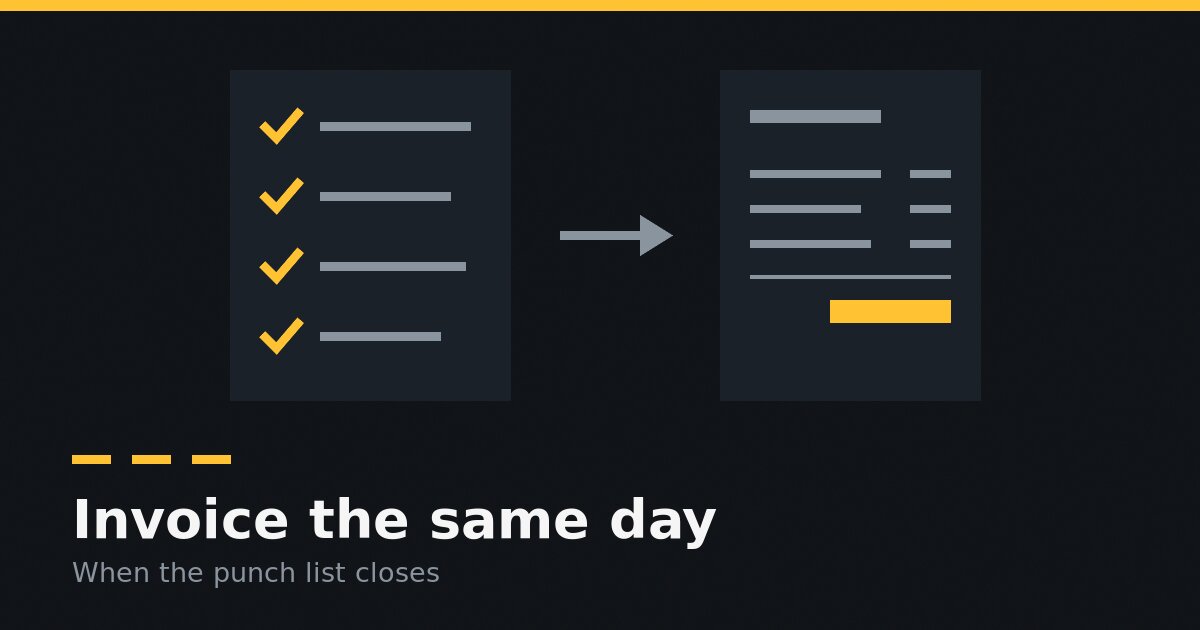
Send the final invoice the day the punch list is signed off. The work is fresh, the customer has just agreed it's done, and every day you wait adds a day to when you get paid without making the invoice any more accurate. The way to do it is to build the invoice before the last punch item gets fixed, so there's nothing left to do but send it.
The customer's payment terms don't start until the invoice arrives. Net 30 from a late invoice is net 51 from the day the job was done.
What the wait costs
The interest is the smallest part of it, but it's real. Say you invoice $1.2 million over a season and each final invoice goes out 12 days after the punch list closes. At 9 percent on a line of credit, carrying that money 12 extra days costs $1,200,000 × 0.09 × 12 ÷ 365, or about $3,551. That's money spent on nothing but a slow invoice.
The bigger costs don't show up as a number:
Payment runs. A lot of companies cut checks on a set schedule, twice a month or once a week. An invoice that misses a run waits for the next one.
Memory. Three weeks after the job, nobody in the customer's office remembers the property manager saying yes to the extra crack fill. The signed change order settles it, but now it's a phone call instead of a check.
Cash for the next job. The plant wants paying on your terms whether or not your customer has paid you.
Build the invoice before the last item is fixed
The final invoice doesn't depend on anything that happens after the punch list. Your price to the customer was set when they signed. So build it while the crew is still out there fixing the catch basin:
- Start from the signed proposal. Not the estimate, not the work order, not memory.
- Add every signed change order, by number, and nothing that isn't signed.
- Take off the deposit if there was one.
- On a unit-price job, fill in the final measured quantities.
- Add sales tax if it applies to the work in your state.
Here's the Maple Street invoice:
- Contract: $46,800.00
- Change order 1, additional crack fill: $3,150.00
- Less deposit received: −$9,360.00
- Due: $40,590.00
The deposit was 20 percent of the contract ($46,800 × 0.20 = $9,360), and $46,800 + $3,150 − $9,360 = $40,590.
The striping sub's bill doesn't belong in this. What you owe the sub is your cost. It changes your margin on the job, not what the customer owes you. Don't hold the invoice for it.
Close the punch list in writing
An invoice sent the day the punch list closes only works if everyone agrees the punch list closed.
Walk the lot with the customer when the main work is done. Write down each item where it is, with a photo: the stall line that's a foot off, the raveled edge at the entrance, the low spot at the catch basin. That list is the whole punch list. New items that show up next month are a new conversation.
Fix them fast, photograph each one fixed, and get the sign-off in writing. "Looks good" on the phone is pleasant. A signature or an email saying the punch list is complete is what goes with the invoice.
Some things aren't punch list items. A tenant's oil leak on the new mat, a tire scuff from a moving truck, the sealcoat on a lot you never touched. Say so kindly, with a photo if you have one, and offer to price the fix.
What goes out with the invoice
Make the invoice easy to approve for someone who has never seen the lot:
- The invoice itself, with the job name and address on it
- Copies of the signed change orders it includes
- The punch list sign-off
- Two or three photos of the finished lot
- A lien waiver, if the customer asked for one with payment
- A due date written as a date: $40,590.00 due September 3
- How to pay, and a way to do it from the email
Payment terms, deposits and what the invoice looks like are all set in the proposal, long before this day. Writing a paving proposal customers sign covers those terms.
When the customer won't walk the punch list
Sometimes the property manager is busy for two weeks and the punch list just sits. Don't let that hold your money forever.
Send the list in writing with photos, and a date to walk it. Fix everything on it. Then send photos of each item fixed and a note that the punch list is complete as of that date, along with the invoice. A customer looking at a photo of every item fixed has little reason to argue about a low spot that isn't there anymore.
On a bigger job, the contract may hold a set amount or a retainage percentage until the punch list closes, and bill the rest when the work is done. That's a term for the proposal, and it keeps a two-item punch list from holding up the whole payment.
After it's sent
Sending it isn't the end. A few days later, confirm it arrived and ask whether anything is missing for approval, like a PO number, a W-9 or a waiver form. Finding that out on day 4 costs a phone call. Finding it out on day 35 costs a month.
For bigger GC jobs, where the final bill is a pay app and retainage follows months later, see working for a GC.
Where Pavr fits
Pavr is job management software for paving, sealcoating, striping and concrete contractors. The final invoice comes off the signed proposal plus every signed change order, and a deposit comes off it on its own. It can't go out while the punch list is still open. The customer walks the punch list on their phone, item by item with the crew's photos, and signs off or flags the one that isn't right. Send the invoice and they get the PDF by email with a Pay button. It goes to your QuickBooks payment page, or to wherever you already take payments, and Pavr takes nothing on it. Turn on Pavr Payments and the customer pays right on the invoice, by bank transfer or card, into a Stripe account in your business's name, for 1% plus Stripe's rates, and a check always works. If it goes unpaid, reminders go out at 7, 14 and 30 days past due.
Questions contractors ask
Should I wait for the sub's invoice before I send the final invoice?
No. What the sub charges you is your cost. What the customer owes you was set when they signed the proposal and change orders.
Can I send the final invoice before the punch list is done?
If your proposal says so, you can bill the work and hold back a set amount until the punch list closes. Without that term, billing before the punch list is done invites the customer to hold the whole payment.
What date should go on the invoice?
The day you send it. Then write the due date out in full, so nobody has to count days from a term like net 30.
What if the customer finds new items after signing off?
Look at them. If it's your work, fix it under your warranty. If it's damage from someone else, show the photos from sign-off day and offer to price the repair.
Was this useful?
It tells us what to write more of.