The GC's project manager sends the subcontract on a Thursday afternoon. It's 38 pages. Pay applications are due on the 25th of each month on the GC's forms, a conditional lien waiver goes with every one, retainage is 10 percent, and payment is due "within ten days after Contractor receives payment from Owner." Your crew will place the base and binder in June and come back for the surface course in October. The building opens in November.
None of that is unusual. Working for a GC is steady work with bigger jobs and a slower, more formal way of getting paid. Learn the cycle once and it runs the same way on every project.
How pay apps work when you're the sub
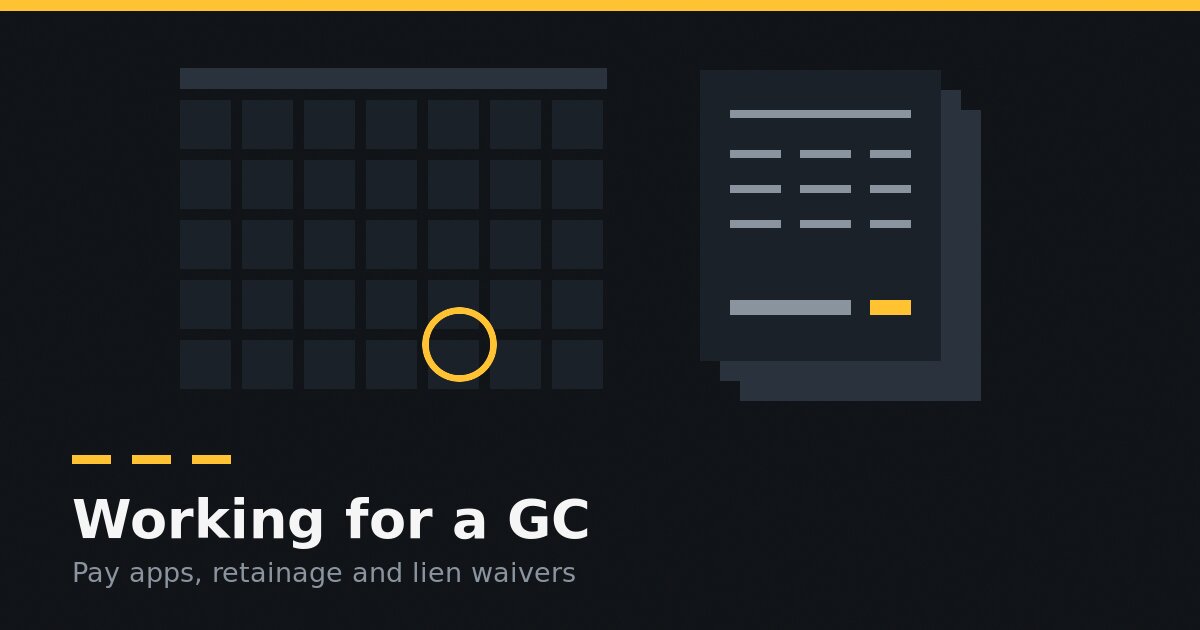
When you work for a general contractor, you get paid through the GC's monthly pay application. You send your pay app for the work done that month by the GC's cutoff, usually on their forms and with a lien waiver. The GC rolls it into its own application to the owner, the owner pays the GC, and the GC pays you, less retainage, on the schedule the subcontract sets.
That means your money is tied to three things you don't control: the GC's cutoff date, the owner's approval, and the payment clause. The things you do control are getting the pay app in on time, getting it right the first time, and knowing what the contract says before you sign.
Read the subcontract before the crew mobilizes
Find these before you sign, not when the first check is late:
The payment clause. Under pay-when-paid, the GC pays you within a set time after the owner pays the GC. Under pay-if-paid, the GC can argue it never owes you if the owner never pays. Many states limit pay-if-paid clauses, so find out what yours allows before you accept one.
The pay app cutoff and format. The date, the forms, whether they want a draft first, and who gets it.
Retainage. The percentage, whether it drops partway through, and what triggers release. Watch for release at "final completion of the project" when your work is done in month two. The retainage and progress billing post goes deeper on what that wait costs you.
Lien waiver forms. Whose forms, and when each kind is required.
Change orders and notice. How much time you have to give written notice of a change, and who can authorize one. Some subcontracts say a claim not made in writing within a set number of days is waived.
Insurance and backcharges. The certificate you need before you mobilize, the additional insured wording, and what the GC can charge back to you for cleanup or damage.
Mobilizations. A site that phases the work can have you coming back three times. If the proposal priced one move-in, that's your margin going down the road on a lowboy.
Build a schedule of values that follows the work
The schedule of values is your contract price broken into lines. Break it where the work actually happens, so each month's bill matches what the GC's superintendent can see. Say your package on a new retail lot is $142,000:
- Mobilization, two trips: $7,000
- Stone base and fine grade: $30,000
- Binder course: $52,000
- Surface course: $41,000
- Striping and signs: $9,000
- Punch list and cleanup: $3,000
Put real value on mobilization and early work. If you bury it in the surface course, you're carrying the cost of the first trip until October.
The monthly cycle, with numbers
June. The crew places stone and binder. Your pay app bills the first mobilization, $3,500, plus stone base at 100 percent, $30,000, plus binder at 100 percent, $52,000. That's $85,500. The GC holds 10 percent retainage, $8,550, so the amount due is $76,950.
It goes in by June 25. The GC bills the owner, the owner pays sometime in July, and under a ten-days-after clause your check lands late July or into August. That's work done in June, paid for six or eight weeks later, and that's when everything goes right.
October. The crew comes back for the surface course and the striping. You bill the second mobilization, $3,500, the surface course, $41,000, and striping, $9,000, for $53,500. Retainage is $5,350, and the amount due is $48,150.
Closeout. The punch list and cleanup, $3,000, less $300 retainage, go on the last pay app. By then the GC is holding $8,550 + $5,350 + $300 = $14,200, which is 10 percent of the whole $142,000. You get that back when the release condition in the subcontract is met, and you have to ask for it.
Lien waivers without giving away your rights
A lien waiver says you give up lien rights for a payment. There are two questions to ask of every one: is it conditional or unconditional, and is it for a progress payment or the final one?
A conditional waiver only takes effect when you actually receive the payment it names. That's the one to send with a pay app.
An unconditional waiver takes effect when you sign it, whether the money came or not. Sign it only after the check has cleared.
Some states require specific statutory waiver forms, and some set deadlines for preliminary notices that protect your lien rights in the first place. Your state's lien statute sets those rules, and a construction attorney can tell you in an hour what your standard practice should be. On public projects you generally can't lien the property at all, and payment bonds take the place of liens.
What gets a pay app sent back
A rejected pay app doesn't come back in a day. It often means missing the cutoff and waiting for next month's cycle. These are the usual reasons:
- Percent complete the super doesn't agree with. Claiming 80 percent on binder that's half down gets every pay app after it picked apart.
- A missing waiver, certificate of insurance or form. On public jobs, certified payroll is on this list too.
- Change order work the GC hasn't approved. Bill a change only after the GC's written change order exists, even if the super told you to do it.
- Arithmetic. Previous billings that don't match what the GC has on file, or retainage figured on the wrong number.
Many GCs want a draft, often called a pencil, a few days before the cutoff. Send it. Agreeing on the percentages with the superintendent before the formal pay app goes in is the cheapest way to get paid on time.
Change orders when the owner is two steps away
On a lot you price directly, the property manager can sign a change order in an hour. On a GC job, the GC usually needs the owner's approval before it can approve yours. That takes longer, so the notice has to go in sooner.
Put it in writing the day you find the condition, with photos. Price it, and send it to the person the subcontract names. The field direction from the super to "go ahead" is a reason to write the change order, not a replacement for one. The change orders on paving jobs post covers pricing them.
Backcharges and the daily log
GCs charge subs back for cleanup, damaged curb, a lot swept by someone else, or delay. Some are fair. The ones that aren't get settled by whoever has the better record of what happened that day.
Keep a daily log on every GC job: who was on site, what got done, what was in the way, and photos of the curb before your paver got near it. Daily logs that back you up covers what to write down.
Where Pavr fits
Pavr is job management software for paving, sealcoating, striping and concrete contractors. On a bigger job, the schedule of values is built from the lines the customer signed, and each signed change order goes on as its own line. Each period you enter the percent complete on each line. The pay application bills what was done since the last one and holds retainage from the first application to the release, with a continuation sheet in the G703 layout the GC's office will recognize.
Questions contractors ask
What's the difference between pay-when-paid and pay-if-paid?
Pay-when-paid sets the timing: the GC pays you within a set period after the owner pays. Pay-if-paid shifts the risk: the GC argues it owes you nothing if the owner never pays. Many states restrict pay-if-paid clauses, so check yours before you sign one.
When should I sign an unconditional lien waiver?
After the payment it covers has cleared your bank. With a pay app, send a conditional waiver.
What happens if I miss the GC's pay app cutoff?
Usually your work waits for the next month's application to the owner, which can push your payment back a full month or more. Put the cutoff on the calendar for every GC job, and send the draft early.
Can I bill for material that's delivered but not installed?
Only if the subcontract allows stored materials, and usually with proof of delivery, storage and insurance. On most paving work the material goes down the day it arrives, so it rarely comes up.
Was this useful?
It tells us what to write more of.