Who each one is for
Pavement Layers calls itself "Pavement Management & Process Software", and its home page lays the
process out: "Prospect → Lead → Estimate → Proposal → Work Order → Job Cost → + more…" [1]. The
footer says "© Pavement Layers Since 2009" [1]. Its FAQ calls it "a Proven Sales Process supported
with Simple to use Software" [2], and most of the site is about that sale: prospects, leads, a sales
pipeline and a proposal that stands out [1].
Pavr is written for the same contractor: five to sixty people, an office manager, a foreman on each
crew, a sub for milling or striping, and QuickBooks. It covers the proposal, then keeps going into the
part of the job that decides whether the money you price is the money you keep: the signature, the
extra work, the crew's hours, the costs landing against the estimate while the job is open, and the
invoice that comes out of what was signed.
Every claim below about the other product is quoted from its own site, with the number of the
source beside it and the date we read it. Where their site doesn't say, this page says so instead of
guessing.
The walk and the price
Pavement Layers measures through a partner tool: its home page lists WheelitOff Measuring as an
integration [1], and its FAQ says WheelitOff "is a separate tool that will only work on an iPad",
listed at $300 [2]. Proposals carry "maps, site photos, your references, insurance + much more" [1],
and the FAQ lists preloaded specifications for "paving, repairs, milling, base repair, infra-red
repairs, sealcoating, crack sealing," "line striping concrete, drainage, curbing, sweeping + more."
[2]
In Pavr you draw the lot on the satellite view, or you set a scale on the GC's PDF plan and draw on
that, or you type in the square feet you walked with the wheel. Then you drop the work onto what you
drew: 131 services come built in across paving, concrete, sealcoat, striping and site work, each priced from your plant price, your crew rates and your equipment, with a markup slider on every line and the margin beside you while you work. How estimating
works shows the whole screen.
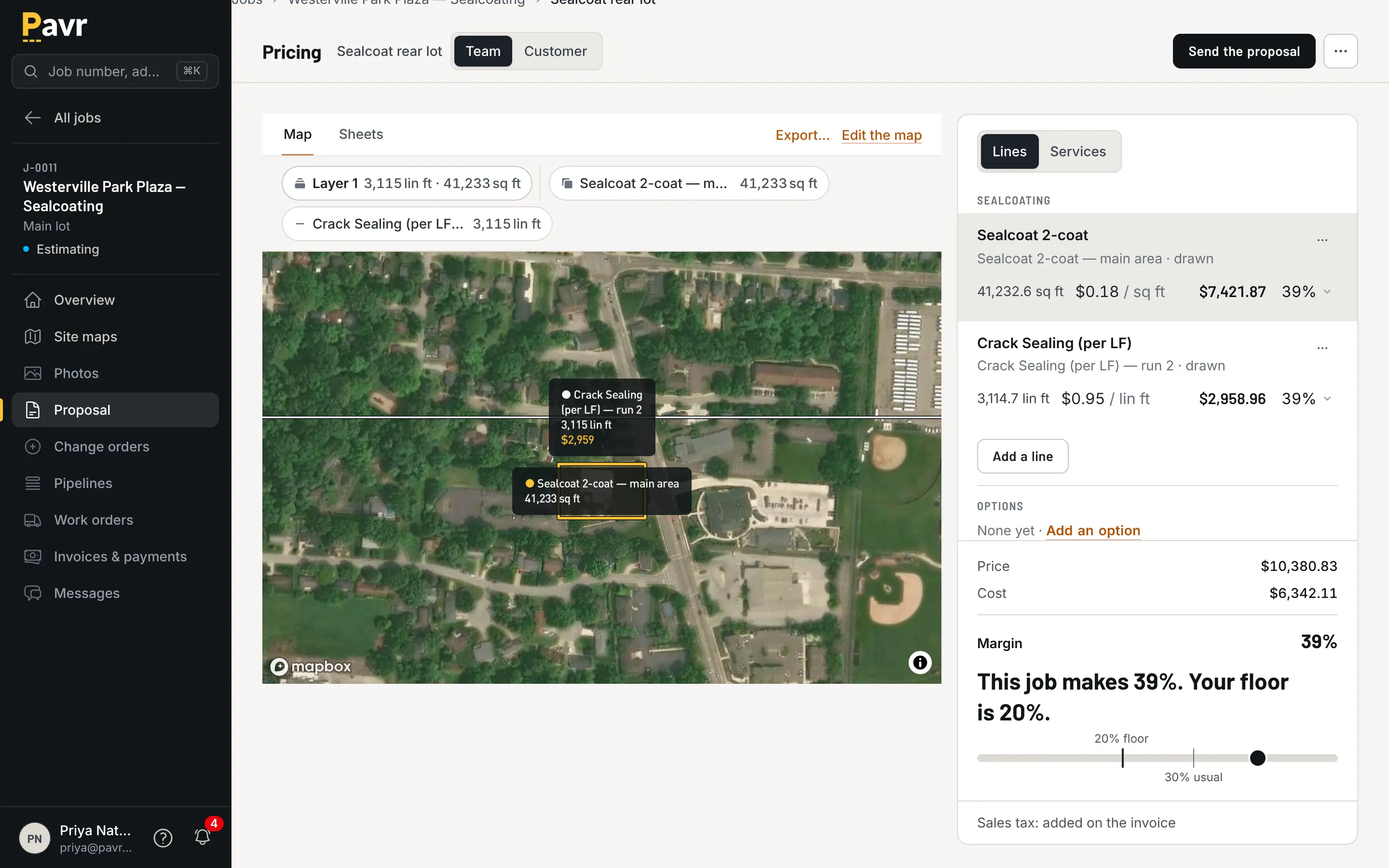
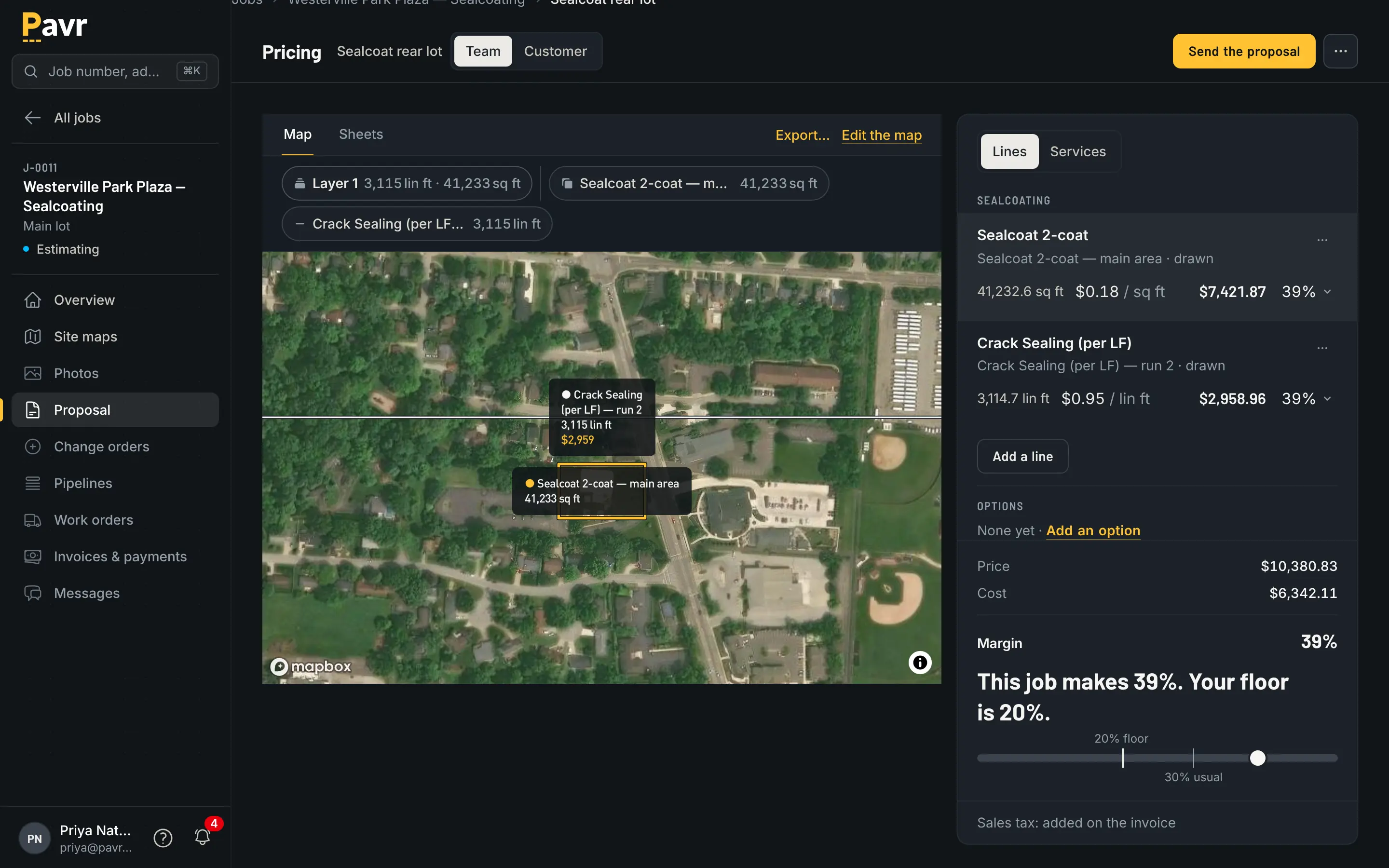
Draw the lot, drop the work onto it, and the tons, the gallons and the crew hours come off the drawing.
A proposal you've sent in Pavr keeps the price it was sent at, and a plant increase never moves it. A
draft picks up the new number when you say so. One estimate can carry the overlay, the ADA ramps,
the sealcoat and the restripe, come out as one proposal grouped by trade with subtotals, and become
one job that each crew sees its own part of. If you want the arithmetic, the paving estimating
guide walks a mill and overlay from the walk to the
sent proposal.
The signature
Pavement Layers sends proposals by email and tracks them: "Sent & tracked via email!" [1], and you
get an email "every time a client opens your proposal" [2]. An electronic signature isn't listed on
their site as of September 18, 2026 [1][2][3].
In Pavr the customer gets an email under your company's name with a link that opens the proposal on
their phone. No password and no app. They sign by typing or drawing, and the signature is
tied to the exact version they were shown. Signing wins the job, with the
trades, the crews and the waits already on it.
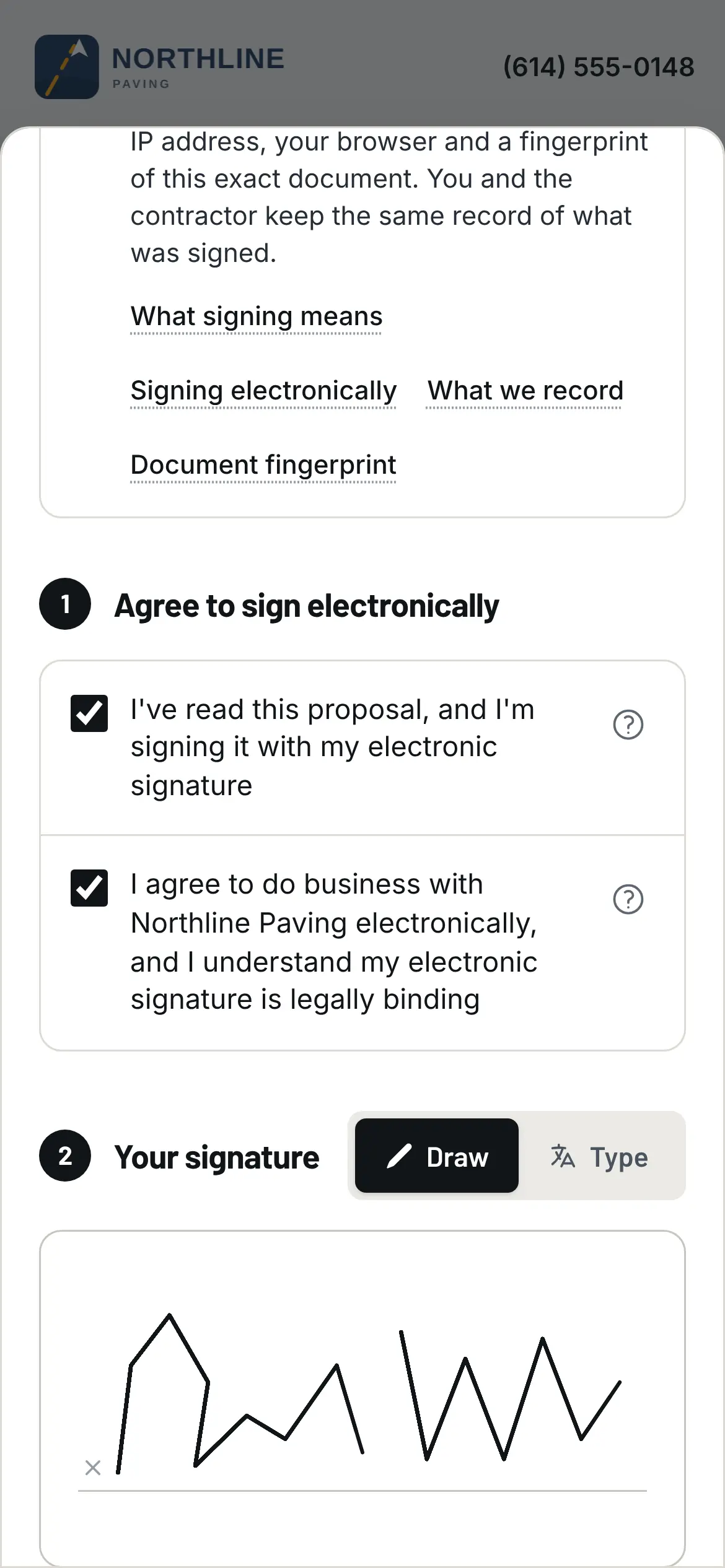
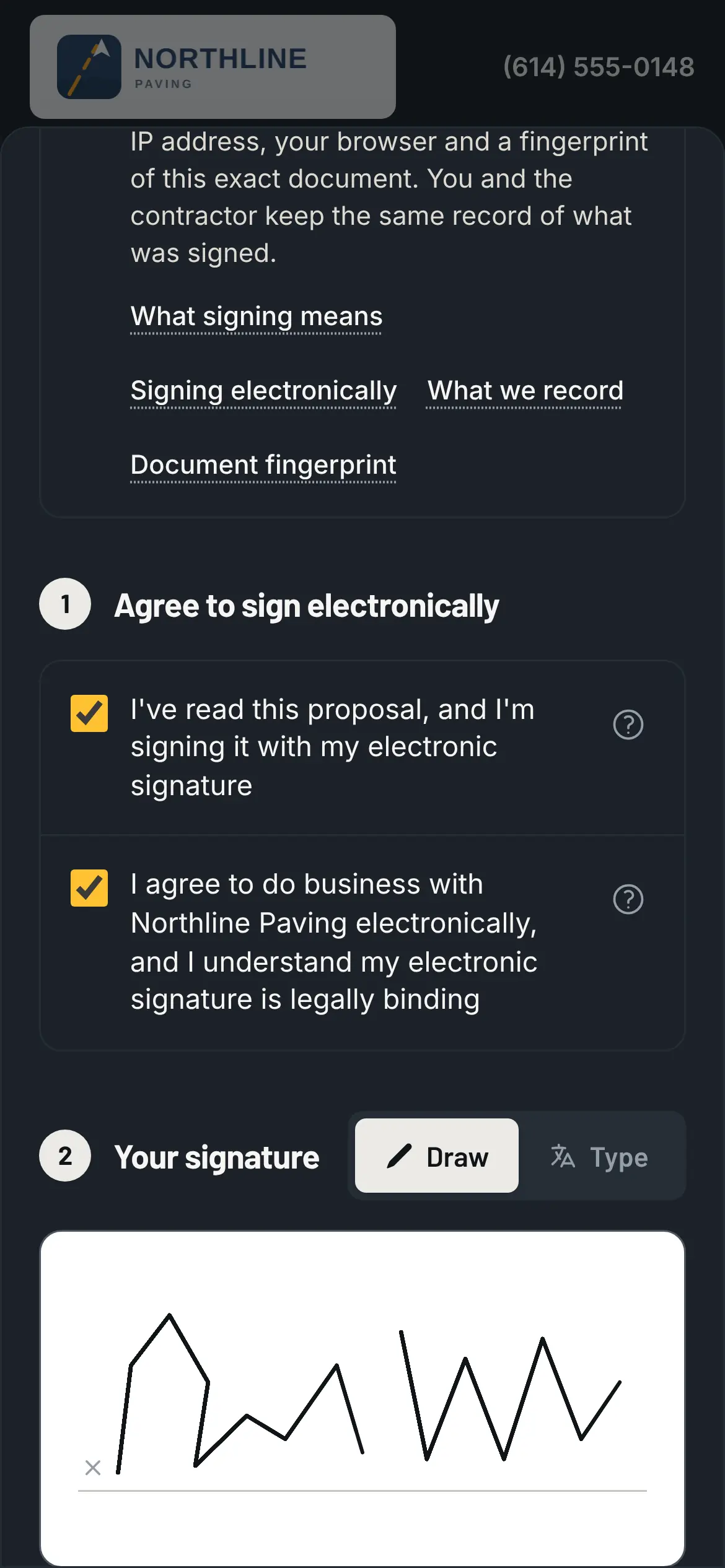
The property manager signs in the parking lot, on the phone, from the email.
Change orders
The extra two inches of base you found when you milled. The ramp the owner wants poured while you're
there. The stalls that went from 48 to 61.
Pavr writes the change order on the job, prices it from your current catalog with the markup the
customer already agreed to on the proposal, and emails it for signature the same way the proposal went.
The part of the job it touches waits until it's signed. Once it's signed, it's on the invoice, or on
the schedule of values as its own line.
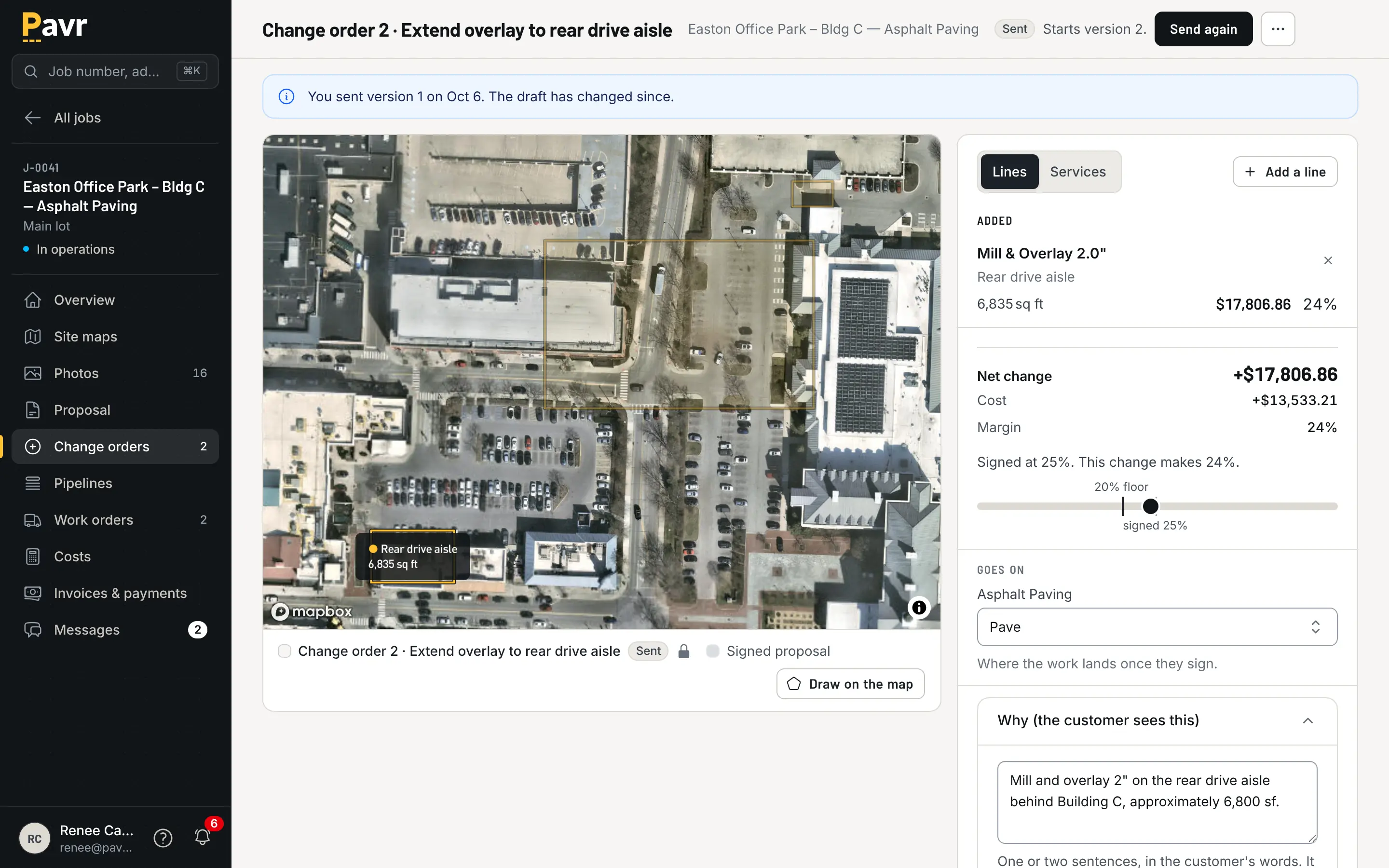
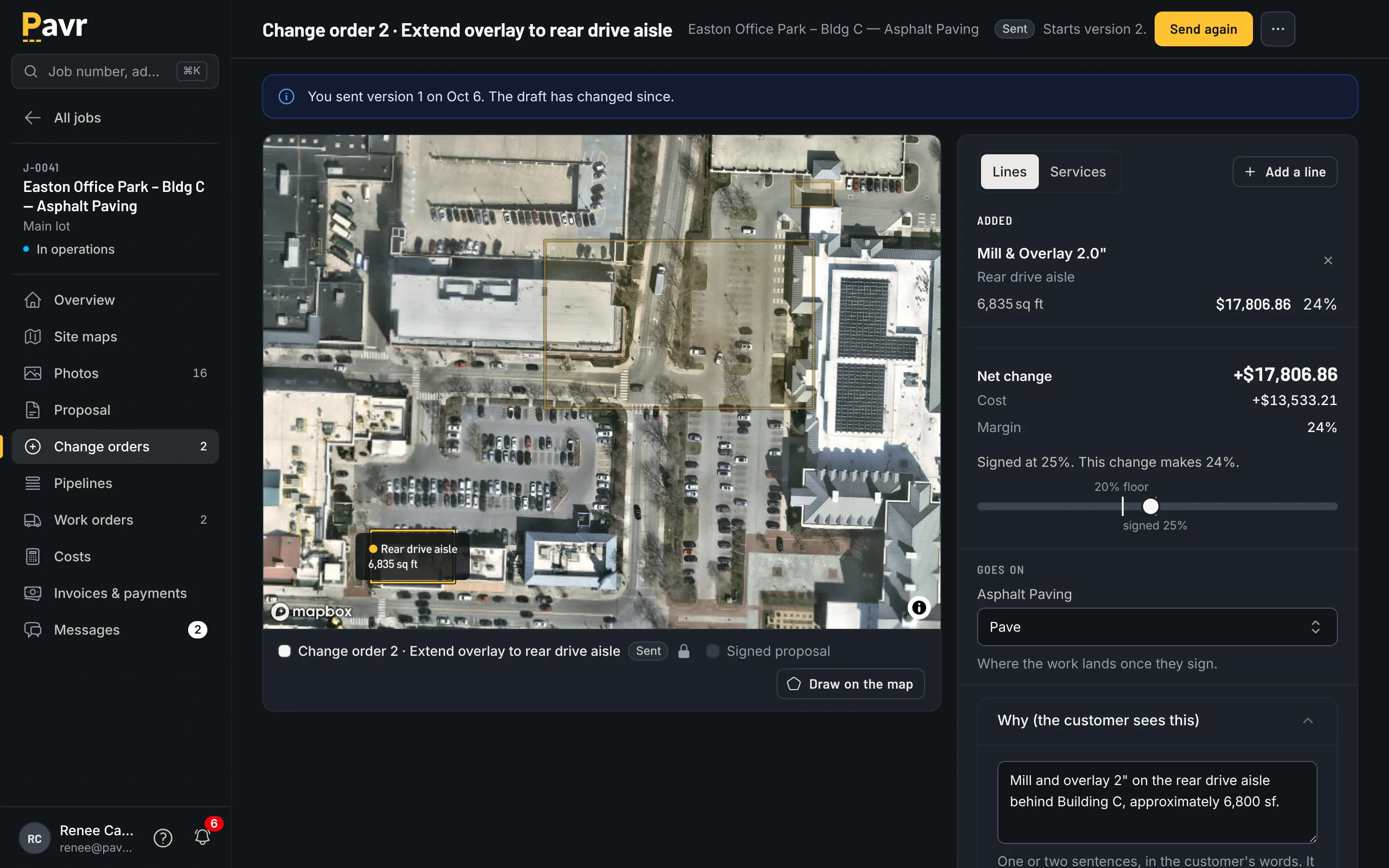
The work waits on the signature, not on somebody's memory of a phone call.
Change orders aren't listed on Pavement Layers' site as of September 18, 2026 [1][2][3]. A signed
change order that never gets billed is a donation, so take a real one from last month into both
trials. The change orders guide has the questions worth
asking.
The week before the crew rolls
Pavement Layers makes the work order: its FAQ promises "Work Orders with a tap" [2], and a lead goes
"to your phone with driving directions" [1]. Scheduling and weather rules aren't listed on their site
as of September 18, 2026 [1][2].
Every Pavr account starts with a rule per trade: asphalt, sealcoat and striping want 50°F and no
rain, concrete 40°F, and you can change any of them. The forecast flags the jobs that won't make it,
and a rain day moves as one batch to the next day that passes. Double-booked crews and equipment
show up before dispatch, and dispatch buzzes the foreman's phone. The trades wait on each other on
their own: the striping waits on the paving, the sealcoat waits 30 days for new asphalt to cure, and
the striping waits 24 hours after sealcoat. How the schedule works has the
rest.
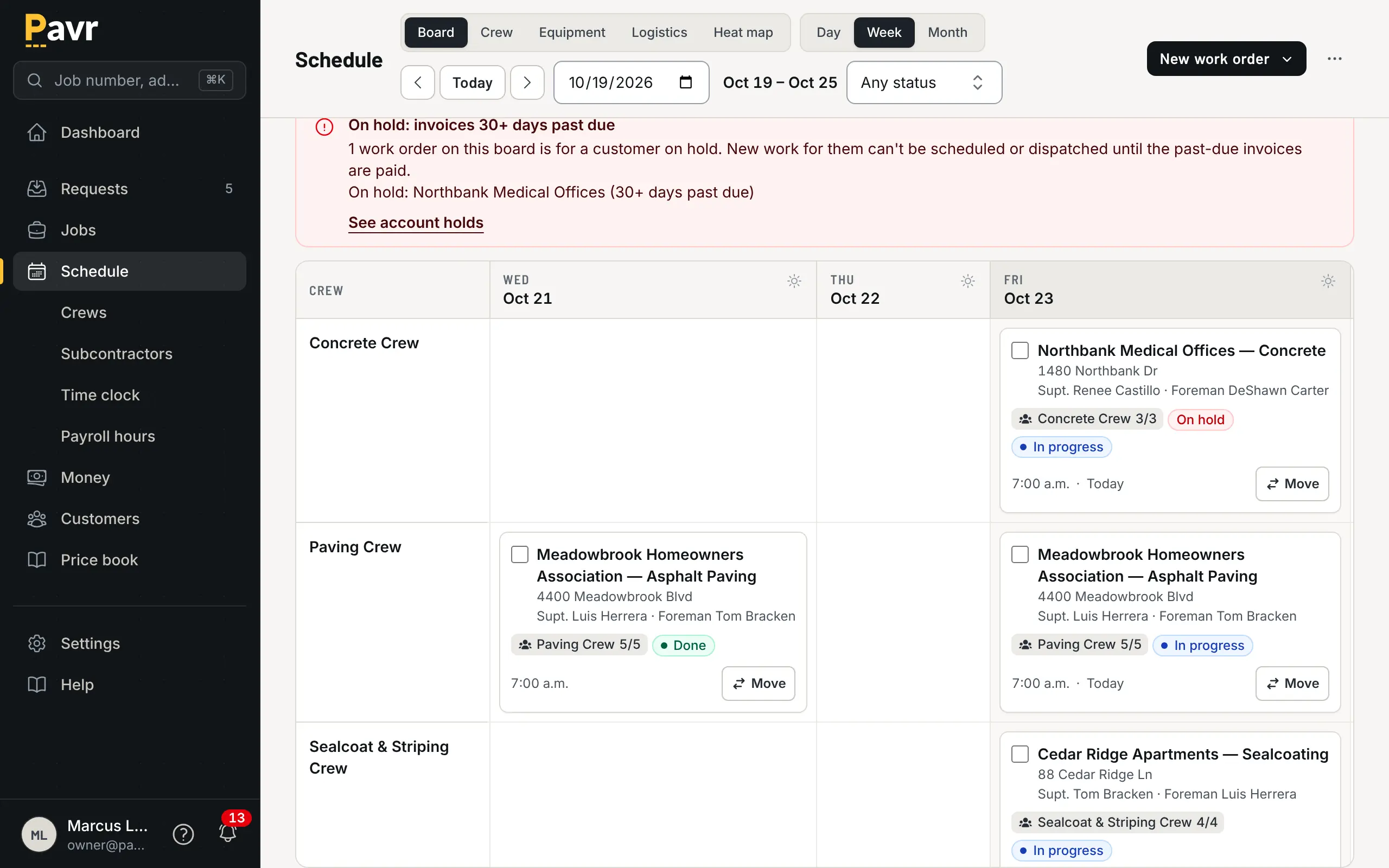
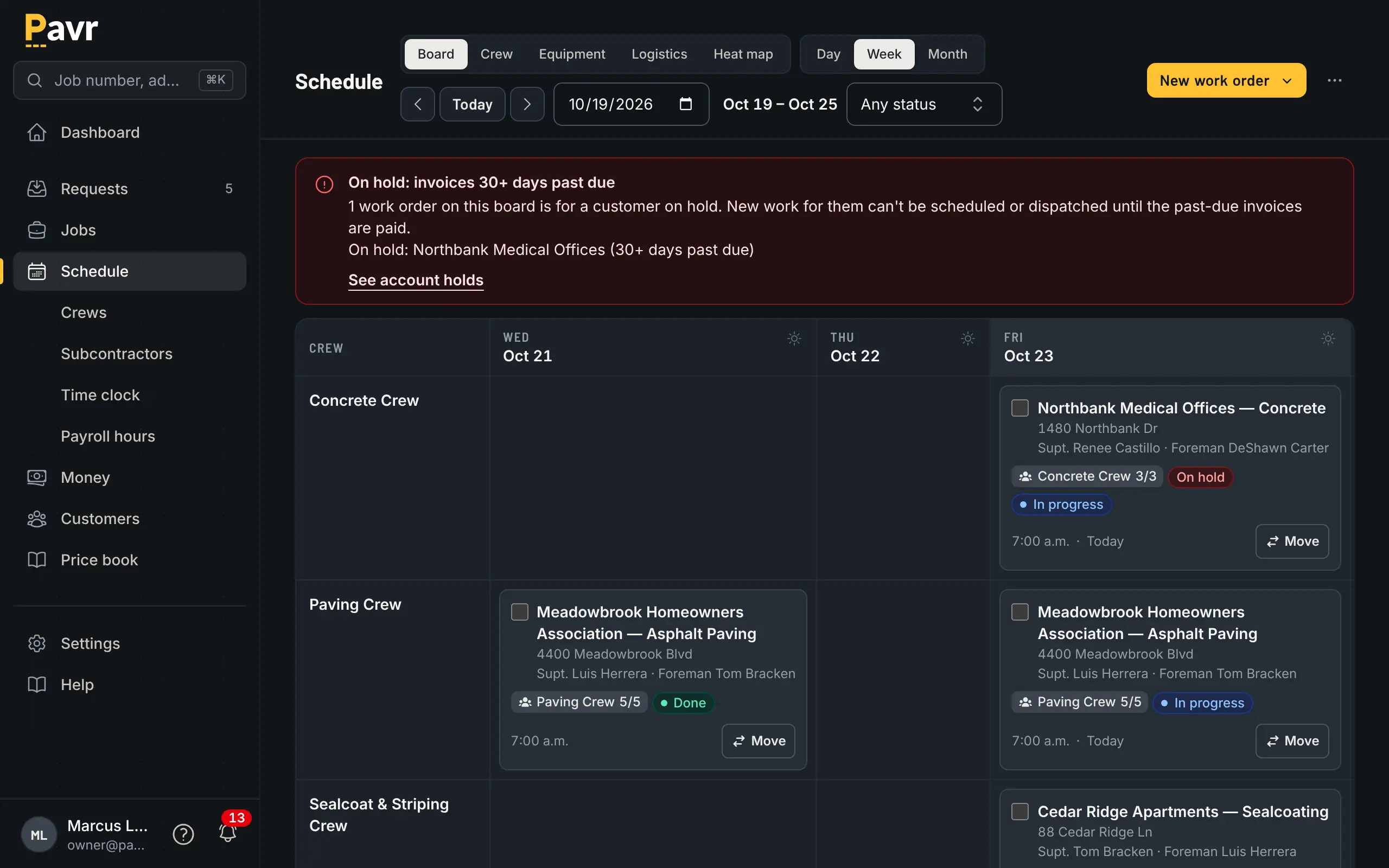
A week with the weather in it: the jobs that won't make the temperature are flagged before you dispatch.
Crew hours
Crew time tracking isn't listed on Pavement Layers' site as of September 18, 2026 [1][2]. Its FAQ is
plain about signal: "If you do not have internet access, you will not be able to use Pavement
Layers." [2]
In Pavr the crew clocks in on the phone with their location, the foreman can clock the whole crew in
at once, and lunch comes off. The daily log carries photos, material used and punch list items. All
of it saves on the phone with no signal and goes up when there's some, and nothing is sent twice.
Approved hours come out as a payroll CSV with the overtime split at 40 hours a week. The crew side
works in Spanish.
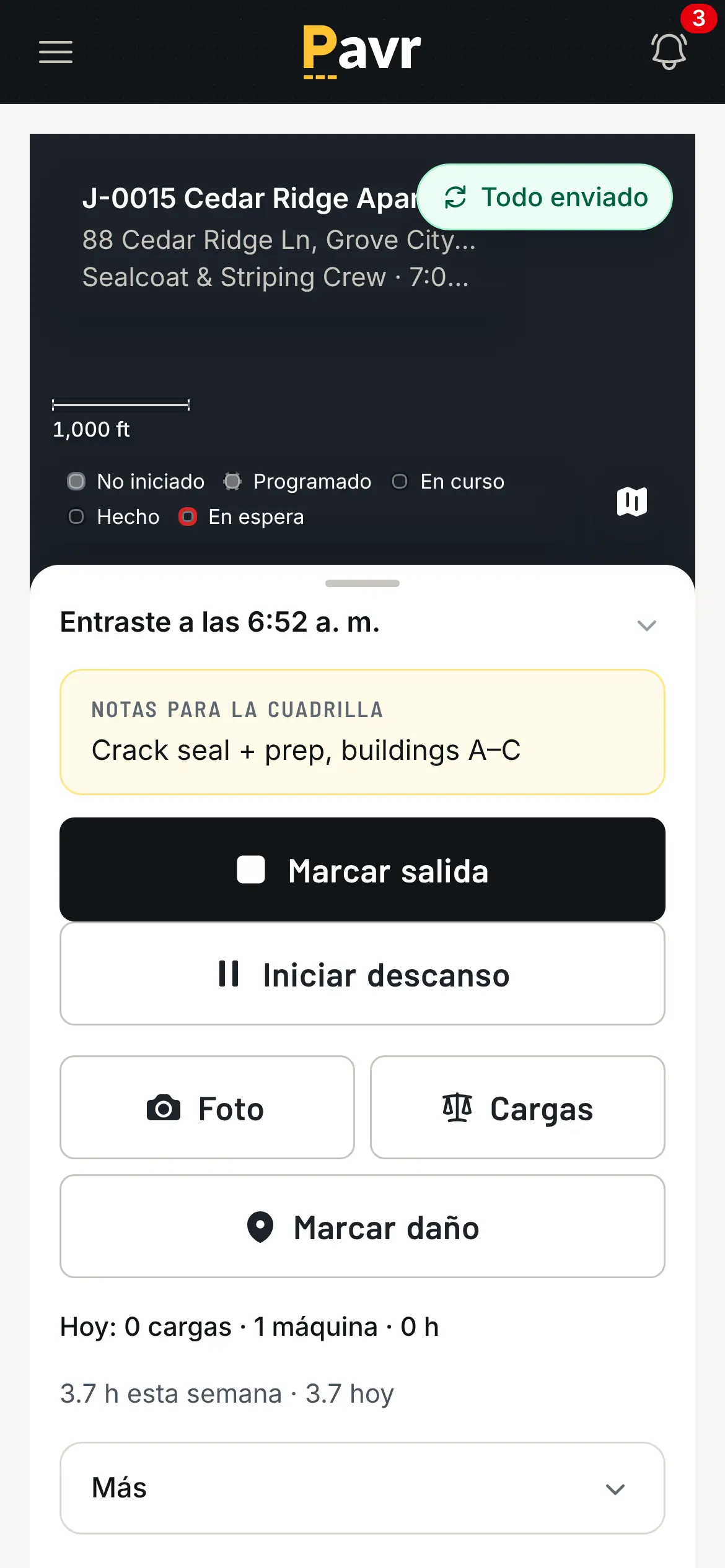
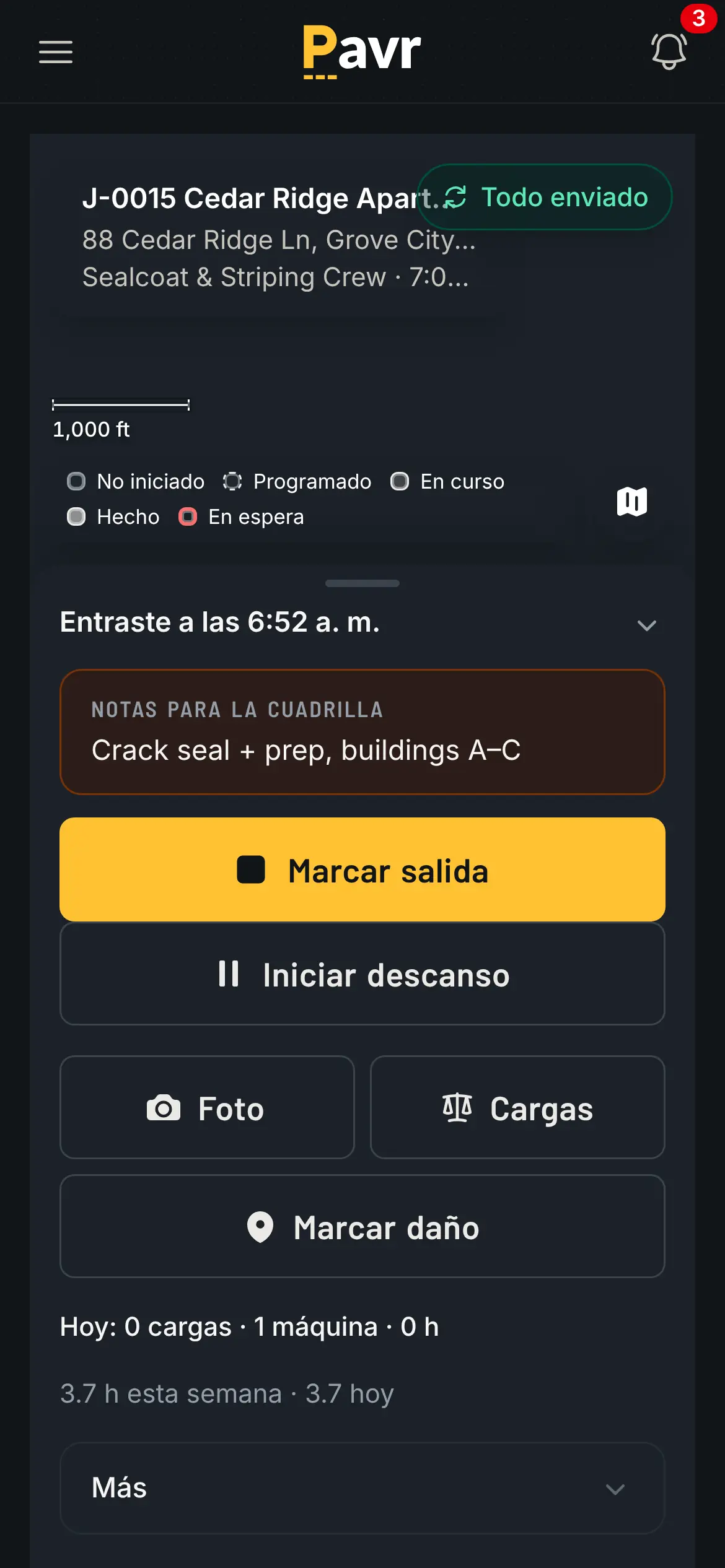
The clock screen in Spanish, because the crew reading it is the crew clocking in.
Job costing
"Job Cost" is a step in the Pavement Layers process [1]. Their objections page answers "You don't
have job costing yet?" with "We do for Sealcoating", and says it has "not yet released job-costing
for the paving, concrete and excavation modules" [3]. The page isn't dated, so ask in the demo what's
live today for paving and concrete.
Pavr posts approved hours, material off the daily log, receipts, sub invoices, mileage and equipment
hours against the estimate line by line, on every trade, while the job is still open. A line turns
yellow at 5% over the estimate and red at 10%, and you set both numbers in Profit
Tracking. One job over is noise. The same line over on every job of one
type is the estimate.
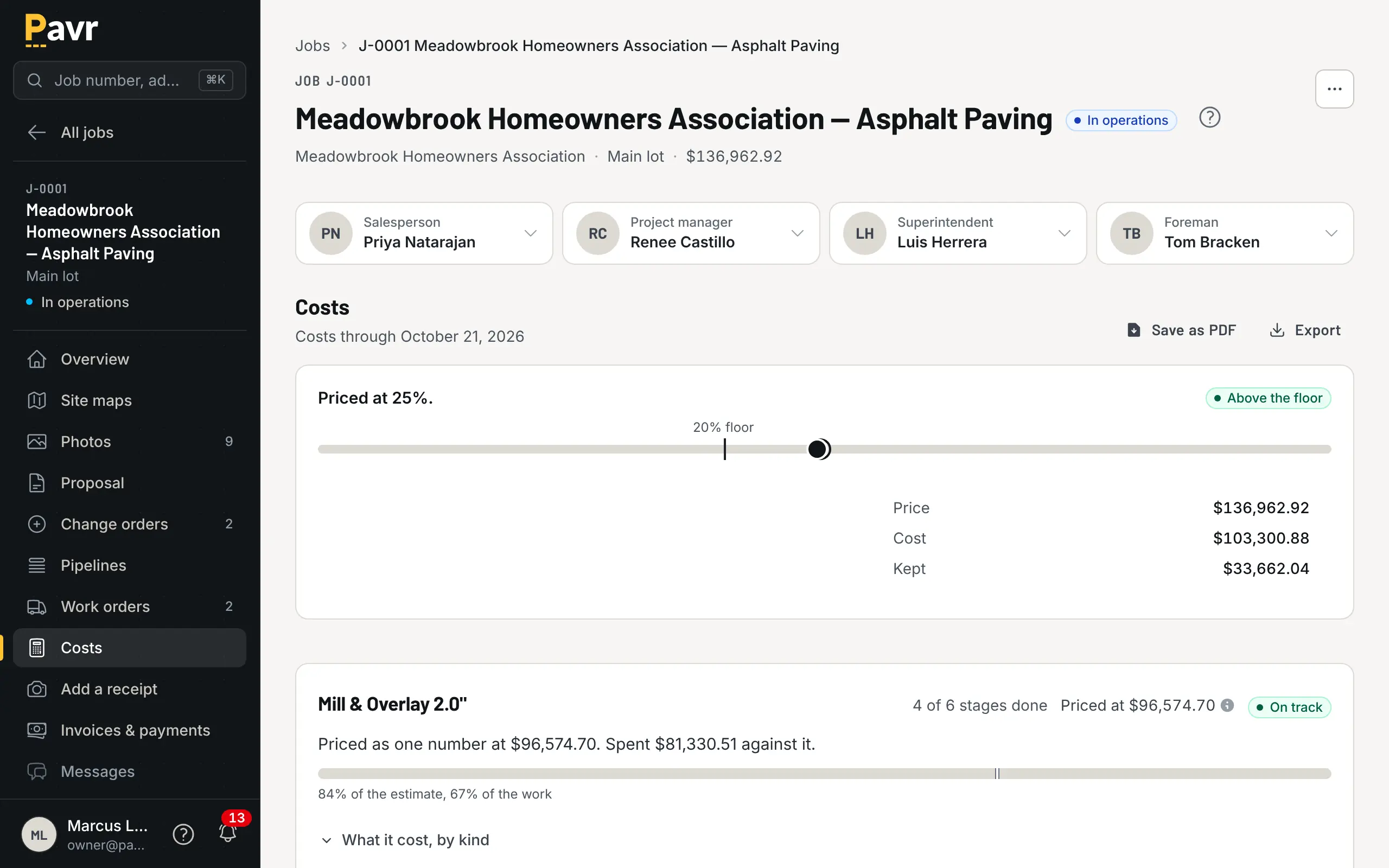
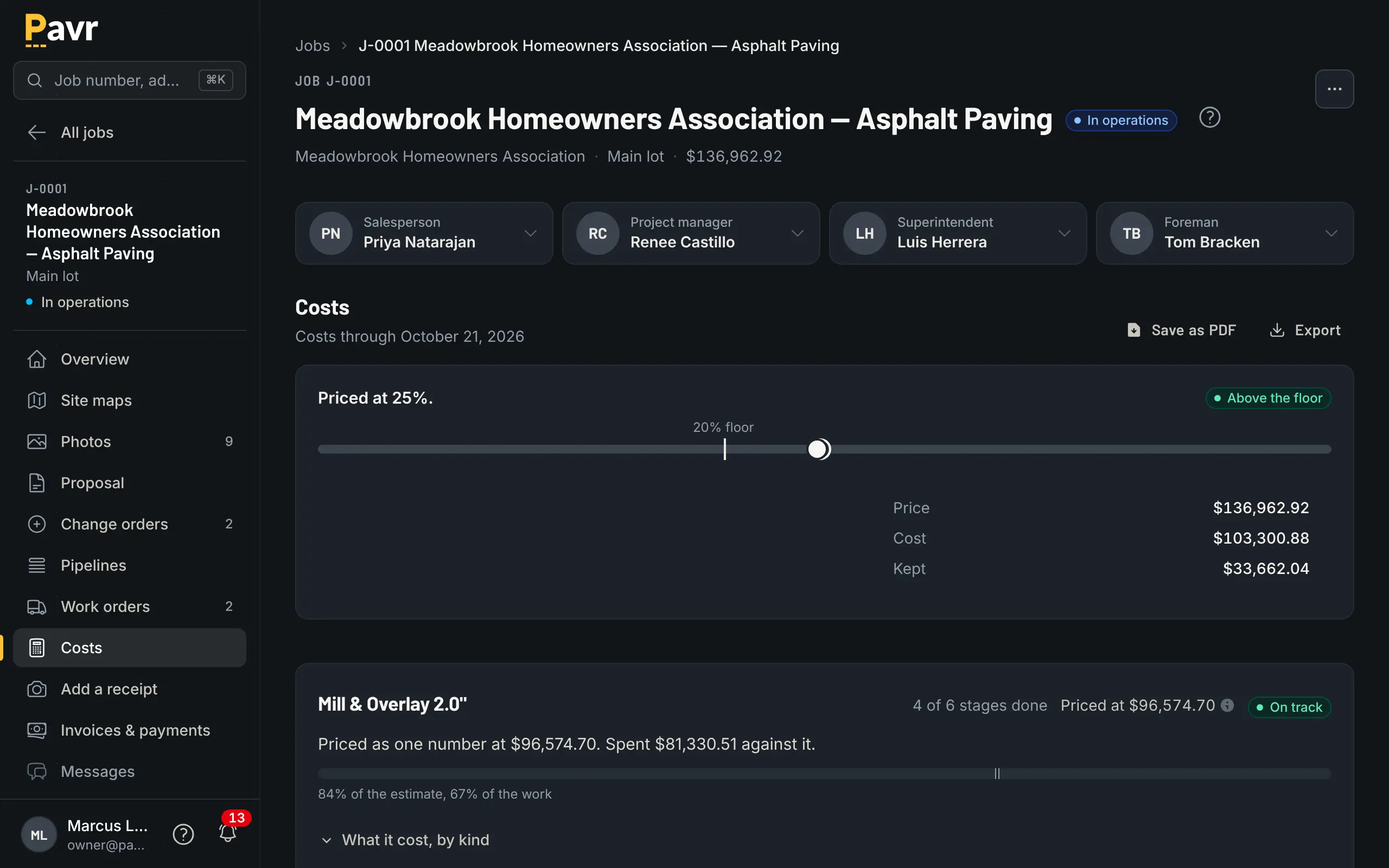
Tonnage over, hours under, and the line that's red before the job closes.
Billing and getting paid
Pavement Layers' FAQ describes the process running to Job Cost "then to your invoicing system" [2].
Invoicing inside the software, progress billing and retainage aren't listed on their site as of
September 18, 2026 [1][2][3].
In Pavr the invoice comes from what was signed: the proposal plus the signed change orders, once the
punch list is closed. The customer gets the PDF by email with a Pay button that goes to your
QuickBooks payment page or wherever you already take payments, with no fee from Pavr; turn on Pavr
Payments and they pay on the invoice, by bank transfer or card, for 1% plus Stripe's rates. A deposit
comes off the final invoice on its own, and reminders go out at 7, 14 and 30 days
past due.
Bigger lots bill the way paving gets paid. A schedule of values is built from the signed proposal, pay
applications go by percent complete on each line, retainage is held and released, and there's a
G703-style continuation sheet. T&M bills weekly against a not-to-exceed and stops at it. If you work
for GCs, working for general contractors: pay
apps explains what to look for.
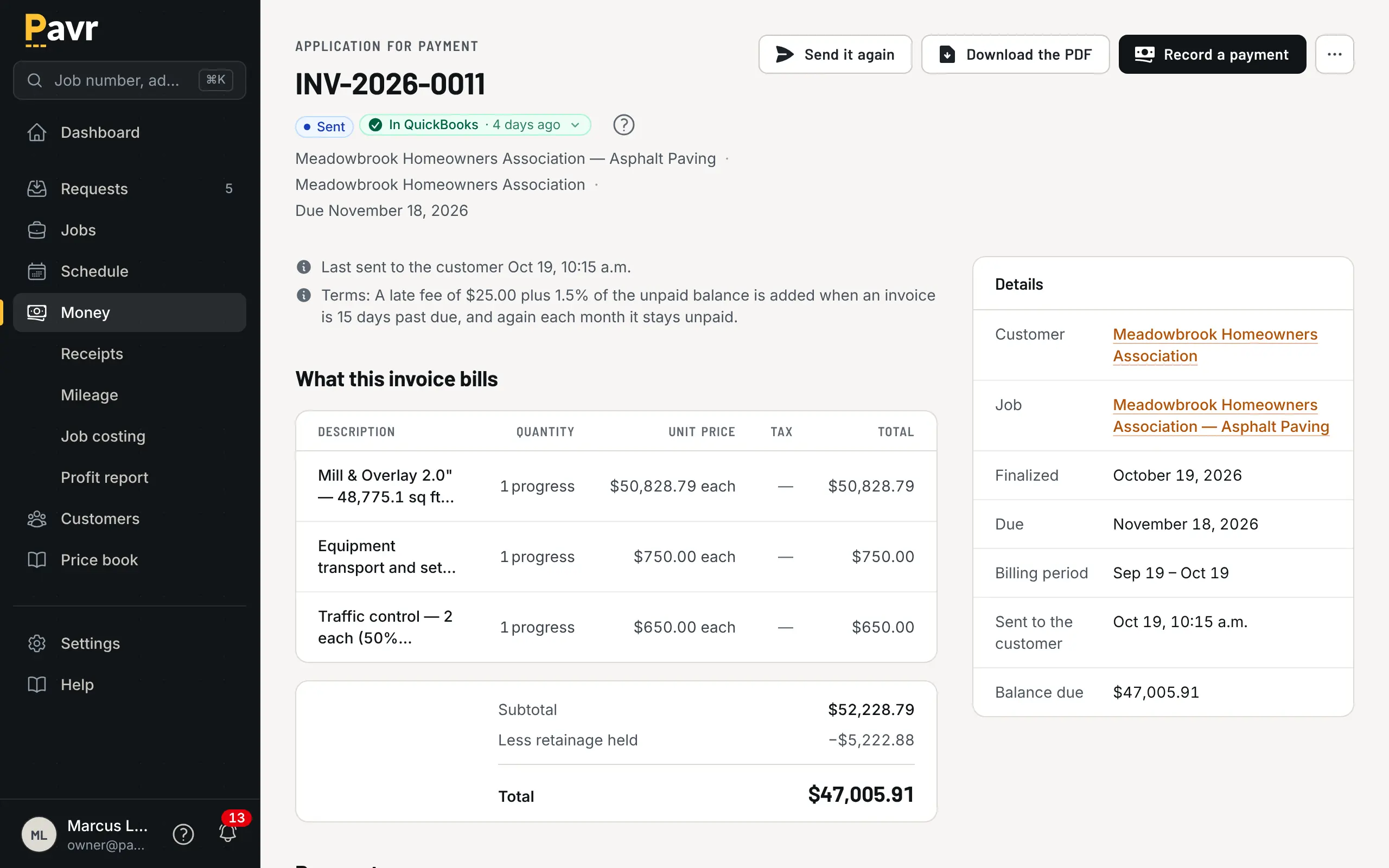
Pay application by line, retainage held, and the customer's copy ready to send.
QuickBooks
Pavement Layers lists "One click integration with Quickbooks desktop and online" [1], and its FAQ
says the same: "Yes. With both desktop and online version." [2] Pavr sends invoices to QuickBooks
Online and brings payments back without double counting, and it doesn't work with QuickBooks
Desktop.
Price
Pavr is $85 a month for each person who estimates, schedules or runs jobs in it. Crew who only clock in,
and customers who sign and follow their jobs, are free. Try it for 14 days with no credit card.
Pavement Layers bills by the year [2]. Its home page lists $2,500 per person per year for 1 to 5 users,
$2,200 for 6 to 20 and $1,900 for 21 or more, with office staff at $500 a year [1]. Its FAQ gives
different numbers, "$2,200 per year/user" with office staff at "$300/year", and says "we do not do
monthly billing." [2] Pavement Layers offers a 14-day trial too [1][2].
Here's the arithmetic at the home page rates. An owner and an estimator as full users, with an
office manager at the office-staff rate, come to $5,500 a year, about $458 a month [1]. At the FAQ's
figures the same three come to $4,700 a year, about $392 a month [2]. Those three on Pavr cost $255 a
month, $3,060 a year. Ask them which price list is current, and whether a foreman who needs work
orders on the phone counts as a full user.
Where Pavement Layers is the better fit
Your books are on QuickBooks Desktop. Pavement Layers lists QuickBooks desktop and online [1].
Pavr connects to QuickBooks Online only.
The proposal is your sales process. Preloaded specifications across paving, milling, sealcoat,
striping, concrete, drainage and curbing [2], proposals with maps, site photos, references and
insurance [1], and an email the moment a client opens one [2]. If winning the work is the part you
want help with, that's their pitch.
You want the vendor to set you up and bring your data in. Their FAQ says setup, customization
and training are included, and that you can import and export data [2]. Pavr reads your material, crew-rate, equipment and sub price lists from a file and gives the owner every record back as CSVs; services, markups and customers you type in. Their site also says they've been at it since 2009 [1].
Switching: what moving actually looks like
Your price lists come in from a file. Material, crew rates, equipment and subs are read from the lists you keep, and you check every row before anything is saved. The 131 built-in services give you the shape, mill and overlay by depth, base repair, crack fill by the foot, sealcoat by the square foot, stalls by the stall, and you set the markups once. An afternoon.
Old jobs stay where they are. Close out what's open in the old system, and start new estimates in
Pavr from a clean date.
Your data comes back out. Export your data gives the owner a ZIP with one CSV per record type
and a README explaining each file. You can pull it the day you sign up.
A sensible first two weeks. Week one: your prices in, one lot priced, one proposal signed by you on
your own phone. Week two: one real job dispatched, one crew clocking in, and the invoice at the end
of it.